A customer opens your report in a supermarket queue. There are eleven coloured boxes, a close-up of something black and a note that says “NSF low.” They want three answers. What did you find, how urgent is it, and what do you need them to decide?

Put those answers at the top. Then show where you found the issue, the evidence behind it and what a technician recommends. A useful vehicle health check gives the customer enough information to make a decision and gives the next person who opens the job a clear record.
In January 2025, the RAC and TyreSafe reported that 39% of drivers in their sample correctly identified 1.6 mm as the minimum tread depth for car tyres. The survey was carried out in September 2024 among 1,775 drivers with a current UK licence who drove at least monthly. A note that says “1.4 mm” without a comparison leaves many people to guess why that matters. Give them the measured figure and the relevant threshold in the same sentence.
Sources: RAC and TyreSafe survey · Highway Code vehicle maintenance guidance
Say which parts of the vehicle the visit covers. A quick visual check during a service might cover tyres, exterior lights and visible fluid levels. An investigation of a braking complaint has its own scope and procedures. In DVSA’s 2025–26 Great Britain data for class 3 and 4 initial MOTs, 10.44% of tests had at least one failure item in the lamps, reflectors and electrical equipment category and 6.10% had at least one brake failure item. Those figures describe MOT test results and give everyday checks some context.
Sources: DVSA MOT data and definitions · DVSA class 3 and 4 defect table
Record the date and mileage so the customer can tell when the assessment was made. If a component can’t be seen or tested within the visit, write not checked and explain why where it affects the next step. Keep that category distinct from green.
Use ordinary words for the status as well as colour. Someone viewing the report on a phone or reading a printed copy should still be able to make sense of it.
| Status | What it tells the customer |
|---|---|
| Red · Action required | Give the action and timing in plain English. If the technician advises against driving, say so clearly and call the customer. |
| Amber · Monitor or plan | Explain what was found, what would change the advice and how or when the garage suggests checking it again. |
| Green · OK at this check | Say what was checked and observed on this visit. |
| Grey · Not checked | Give the reason if useful and say what further inspection is available. |
Keep the recommendation with the evidence. A warning light, a photo or a single measurement can be one piece of the assessment. If the finding needs further tests, record what you know so far and give the customer a choice about the next diagnostic step.
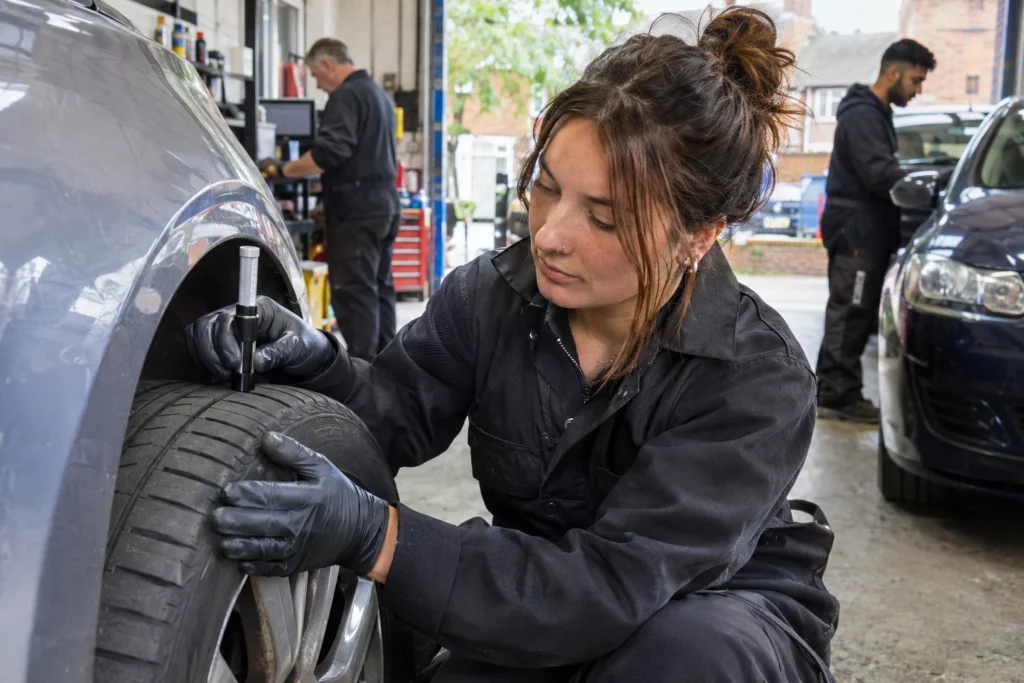
Use location, finding, meaning and action. “Front-left tyre” is easier to picture than “NSF.” Then give the measurement and how it affects this vehicle. Finish with a next step the customer can act on. Keep the technical detail on the job record where it helps the next technician.
A usable photo usually shows something the customer can recognise. Take a wider picture if it helps them find the wheel or component, then a closer one for the detail. When quoting a measurement, record it in text, with the unit and where you took it. If the gauge reading is visible in the picture, check that it’s readable on a phone before sending. If you use a short video, say the component, the finding and the recommended next step in that order.
Show the relevant area and leave unrelated vehicles, people and documents out of the frame. Where images or records include personal data, use your approved system, check the recipient and keep only what you need for the purpose. Tell staff where to upload the images and how to deal with a misplaced file or a link sent to the wrong person.
Sources: ICO principles on data minimisation and security · ICO small business data security checklist
Need a starting point? The free vehicle inspection checklist records each item as OK, advise or urgent and prints as a clean A4 sheet.
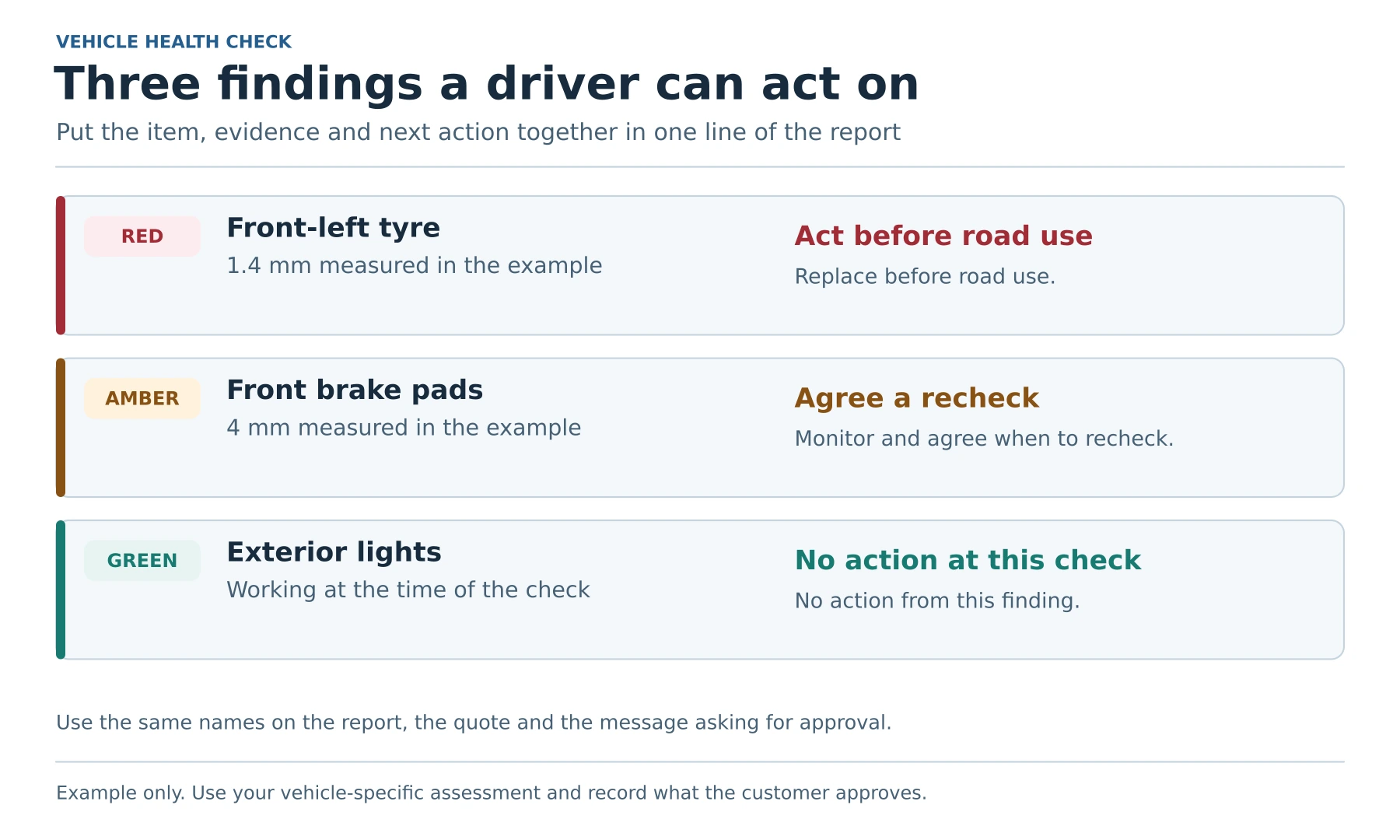
Here’s an illustrative passenger car check in Great Britain at 48,230 miles. It shows how the same report can contain one urgent decision, one item to watch and one successful check.
| Priority | What we found | What we recommend |
|---|---|---|
| Red · Front-left tyre | Lowest reading 1.4 mm in a main groove within the central tread area | Replace before road use. We’ll call to discuss replacement or suitable recovery. |
| Amber · Front brake pads | 4 mm of friction material at the point recorded by the technician | Monitor and agree a recheck based on the vehicle, its use and the rest of the brake inspection. |
| Green · Exterior lights | The exterior lights we tested worked during this visit | No action from this check. |
For the tyre in this example, the minimum is 1.6 mm across the central three-quarters of the tread and around the entire circumference. The pad figure serves a different purpose. A 4 mm measurement here records one observation supporting this technician’s recommendation. Check vehicle-specific guidance, wear patterns and the rest of the system before deciding what advice to give. The DVSA test manual has its own criteria for MOT testers in Great Britain. For example, it classifies a friction lining or pad worn below 1.5 mm as dangerous. Use the appropriate vehicle and inspection criteria when deciding what the measurement means.
Sources: Highway Code tyre guidance · DVSA MOT manual for brakes
The summary message can be short.
“We found 1.4 mm of tread on the front-left tyre, below the 1.6 mm minimum for this car. Our advice is to replace it before the car is driven on the road. I’ll call you now to go through the options. The front pads are also marked for a recheck. The attached report shows the readings and photos.”
If someone asks whether they can drive away, have the appropriate technician or workshop lead explain the finding and the safe options. Record the advice and the customer’s response. GOV.UK explains that vehicles can be unroadworthy even with a current MOT. State the scope of the health check on the report so customers know which items it covers.
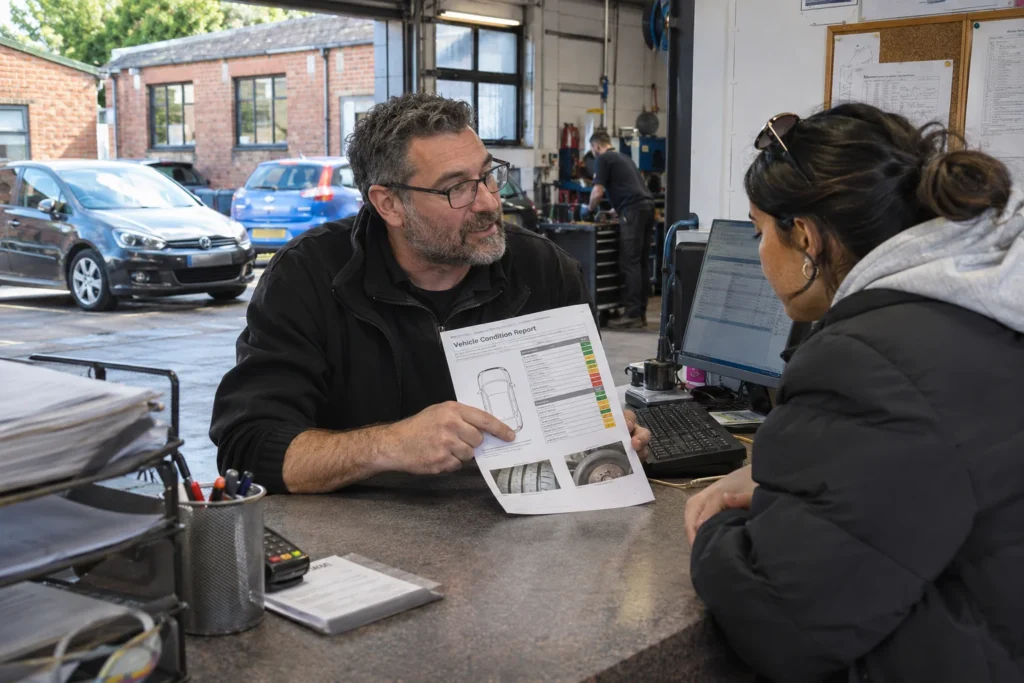
Give the customer the agreed price for anything already authorised, then show the separate extra quote if needed. For example, say “The agreed service is £180 and the replacement tyre is £92, both including VAT. If you approve the tyre, the total will be £272.” These are example figures. Specify what the extra price covers and when you expect to finish. Follow up urgent findings by phone when you can and keep a written record.
Sources: CMA guidance on price transparency · The Motor Ombudsman’s Service and Repair Code
A customer may have read the report and still be deciding. Keep additional chargeable work paused until you have an explicit instruction. Keep the time and channel of the decision on the job, with the exact work the customer agreed to. If they want to delay the amber item, record the suggested recheck date or mileage and who will follow up.
Read five reports from the customer’s side next week. Check how long it takes to spot the main issue, whether photos show anything useful, and whether the work has a recorded decision. Ask reception what customers had to call back to clarify. Change the template around the answers you get. If you use Garage Invoice, inspections support condition ratings, notes, photos and tyre measurements. You can preview the customer PDF before sending, create a quote or job card from the inspection and review which items go on it.
Read more: Garage Invoice guide to recording inspection findings · Garage Invoice guide to sending an inspection · Garage Invoice guide to converting an inspection
