The phone rings while a customer is dropping off keys. A mechanic needs approval for another hour and someone says they need their van back by three. The new adviser has about ten seconds to decide what needs writing down first.

A good first week prepares them for that moment. Teach them to turn a customer’s description into a job a technician can start, agree the scope and price, and tell the customer what will happen next. Give them real jobs with a colleague alongside them, then hand over more of the diary as their notes and promises hold up.
A one-day service adviser workshop listed on the Institute of the Motor Industry’s website follows the job from first call through drop-off and handover. That sequence works as a training plan for a small independent garage too. In RAC research conducted in February 2025 among 1,050 UK motorists who drive at least monthly, 27% saw servicing or repairs as a hassle. The RAC also identified uncertainty over how long the car would be at the garage as an annoyance. A clear next update is something a new adviser can offer from day one.
Sources: IMI listing for a service adviser training workshop · RAC survey and methodology
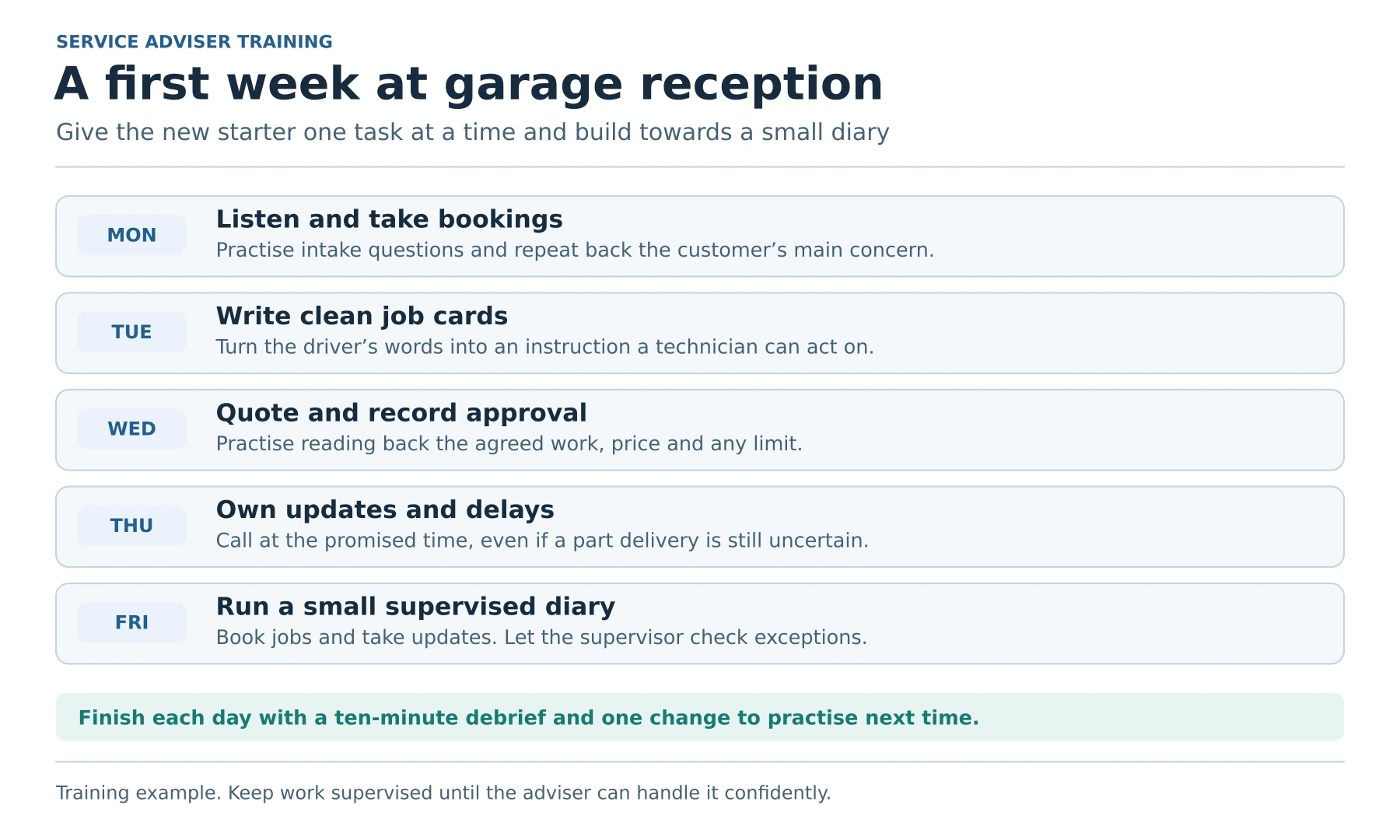
Choose one mentor for the week and show the new starter who answers a technical question, who can set a price and who covers the counter when they take a break. Set aside ten minutes at the end of each day. Review one real booking or call together, fix what needs fixing and pick one thing to try tomorrow.
| Day | What they practise | What the mentor checks |
|---|---|---|
| Monday | Listen to calls and take straightforward bookings with help | The adviser confirms the vehicle, reason for the visit, arrival time and next contact |
| Tuesday | Write up drop-offs and hand work to technicians | The job card preserves the customer’s words and shows the agreed work and limits |
| Wednesday | Explain a quote and record a decision | The customer gets the revised total and latest timing, and the workshop can trace the approval |
| Thursday | Own the updates, including a late job and a customer who can’t be reached | Every open job has a clear next contact and an owner |
| Friday | Run a small part of the diary with supervision | The adviser can hand over an open job and explain what happened on a finished one |
A quiet desk is a good place to practise an awkward conversation. Try a customer who says “just do whatever it needs,” a vehicle with an uncertain fault and a collection time that has slipped. Swap roles so the new adviser hears what a rushed explanation sounds like from the other end of the phone.
Start with the name, registration, best contact and who can agree to extra work. Ask what the driver noticed, when it happens and what they need the garage to do. Check whether they need the vehicle back by a particular time. Confirm the drop-off, what the first visit includes, what it costs where known and when you’ll next be in touch. If the symptom raises a possible safety concern, have the appropriate technician or workshop lead decide what advice to give on getting the vehicle to you.
Source: GOV.UK guidance on vehicle roadworthiness
Try this practice call.
“I’ve booked you for Thursday at eight. We’ll start with the diagnostic session we discussed at £72 including VAT. I’ll call by eleven with what we’ve found and any options. If you need the car before two, I’ll tell the technician now and we’ll talk through what’s realistic.”
The Monday exercise is to separate a booking time, an update time and a collection promise. An adviser can usually own the first two. Confirm the third with the workshop when you know enough about the job. The Motor Ombudsman’s code asks accredited businesses to agree the terms for diagnostic work at booking and give accurate information about timing wherever possible.
Source: Motor Industry Code of Practice for Service and Repair, section 2

“Check brakes” sends the technician hunting for the story. “Driver reports a grinding noise from the front when braking at low speed, first noticed on Monday” gives them something to work with. Keep the customer’s description in one field and the technician’s findings in another. Add the agreed inspection, any price or time limit and when reception has promised to call.
At drop-off, ask whether anything has changed since booking. Check the key and any equipment needed for the agreed job. If the driver says the noise has become much worse, update the job card and tell the technician before the car goes onto the ramp. Teach the adviser to hand over one booking aloud, then ask the technician what was clear and which question they still had to ask.
Before the adviser calls, get the technician’s finding, the proposed work, how urgent it is and what extra time and money it would take. Use the customer’s language. Give the extra charge and the revised total so they can make a decision without doing arithmetic on the phone. For consumer-facing prices, include unavoidable charges and VAT where applicable. If the customer asks a technical question the adviser can’t answer, give a time to call back after checking.
Sources: CMA price transparency guidance · Consumer Rights Act 2015, reasonable care and skill
Here’s a practice quote using illustrative prices. The customer agreed to a £180 service. The technician has quoted £42 for a damaged wiper blade, bringing the new total to £222, including VAT in this example.
“We’ve found a tear in the driver’s wiper blade. I can send you the photo. Replacing that blade is £42, bringing today’s total to £222 including VAT. We still expect to finish by three. Would you like us to include it?”
Record who agreed, when, how, the exact work and the price. The workshop should be able to see the decision before it starts the extra work. If there’s no reply, keep that work paused, tell the technician and schedule another attempt. Record declined work and pass on the technician’s advice clearly if there is a safety concern. The Motor Ombudsman’s code requires accredited garages to seek authorisation before starting additional work and explains how an agreed quote should relate to the invoice.
Source: Motor Industry Code of Practice for Service and Repair, sections 3 and 4
For pricing the extra work, see how to price parts and labour on a garage quote.

Teach the adviser to ask for the next fact they can pass on. If a part is waiting on a supplier, find out when the supplier can confirm availability. Tell the customer the current position and when another update will come, even if the next call simply confirms that you’re still waiting.
“The supplier hasn’t confirmed delivery of the part yet, so I can’t promise you the car at three. I’ll check again at noon and call you by half past twelve. Is there a time you need to make other travel arrangements?”
Put a name and time next to the update. If the adviser is leaving at lunch, hand that call to a named colleague and point them to the job card. At collection, have the adviser talk through the agreed work, the final invoice and any remaining recommendation. Keep technical wording consistent with the technician’s findings. The Motor Ombudsman’s code includes guidance for accredited garages on explaining the work and charges at handover.
Source: Motor Industry Code of Practice for Service and Repair, section 4
At the end of the week, sample ten job cards. Check whether a mechanic could start from the notes, each extra item has a recorded decision, and the agreed updates happened. If you spot complete notes on seven of ten cards and four of five scheduled calls happened on time, you've got two separate things to coach. Those example counts tell you where to look. Then sit in on a real handover. Look for one specific habit to improve the following week, such as writing the next update time while the customer is still on the phone.
A new starter can handle a few jobs on Friday and still need help with a warranty query, a safety concern or a disputed bill. Give them clear escalation routes and keep the daily check-in for as long as it helps. In Garage Invoice, a job card can hold customer and vehicle details, the agreed work and attached files, giving the desk and the technician one place to return to.
Read more: Garage Invoice job card guide · Garage Invoice guide to job card attachments
