The impact wrench works well first thing. By half past ten, the tyre bay is busy, someone’s on the die grinder and the wrench sounds like it would rather go home. Before you shop for a bigger compressor, find out whether you’re running short of air or losing usable pressure on the way to the tool.
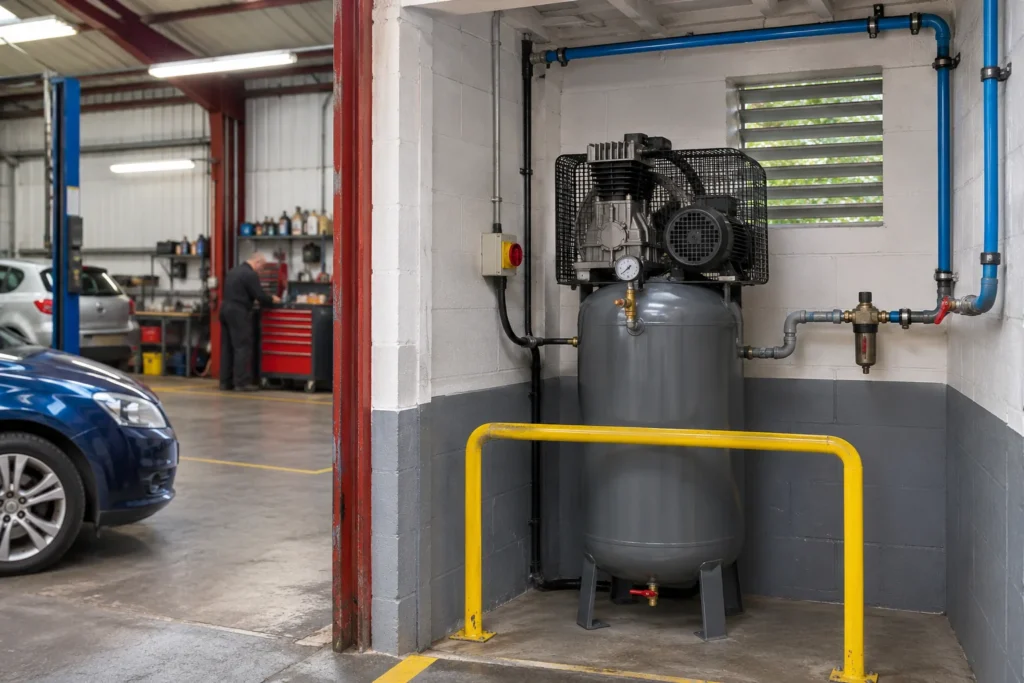
In a small workshop, the best starting point is a list of jobs done at the same time. Then you can compare what the compressor actually delivers, what the building can support and how the air will reach the farthest bay. A week of observations can make the supplier conversation much more useful than asking for “a big enough tank”.
Free air delivery, usually shown as FAD, tells you the amount of air delivered expressed as an equivalent volume at inlet conditions. Compare the FAD at the working pressure you need and ask how the manufacturer measured it. Pump displacement is a different measure and generally gives you a higher number. The receiver is the storage tank. It helps with short peaks, then the pump needs time to replenish it. If your tool uses litres per minute and the compressor lists cubic feet per minute, 1 cfm is about 28.3 litres per minute. Keep the pressure basis consistent when you convert.
Two UK-listed examples show why those numbers are worth reading. In November 2026, Sealey listed its SAC10030VA as a 100-litre, 3 hp unit with 12.4 cfm displacement and 7 cfm maximum FAD. SIP listed its 05481, also a 100-litre, 3 hp model, with 13.6 cfm displacement and 9 cfm FAD. Both list 8 bar maximum pressure. Maximum pressure tells you the limit the maker lists. Ask for delivery data at your required pressure and duty before comparing them for a real installation. These are examples of what appears on a specification sheet.
Sources: Sealey SAC10030VA specifications · SIP 05481 specifications
Assume the tool specifications below are all quoted on a comparable free-air basis at their required working pressure. The figures are illustrative. Read the manual for each of your machines and check whether it gives consumption while running or an average based on intermittent use.
| Equipment | Assumed demand while operating | How it gets used |
|---|---|---|
| Impact wrench | 5 cfm | Short bursts during wheel removal |
| Die grinder | 8 cfm | Several minutes at a time |
| Tyre changer | 4 cfm | Intermittent air demand during fitting |
The grinder and wrench together could ask for 13 cfm at that moment. If the grinder and tyre changer overlap, they could ask for 12 cfm. Add all three only if the workshop really does run them together, which would make 17 cfm. The receiver can help a brief peak. A compressor supplying 9 cfm can’t sustain a 13 cfm demand indefinitely.
Give your installer the overlap and how long it lasts. In this example, the supplier should know that the grinder sometimes runs for several minutes while other people use air. Ask for a quote that accounts for that workload, leakage, usable pressure at the outlet and any growth you genuinely expect. A pneumatic tool replaced by a battery tool might change the answer before you spend anything on the air supply.
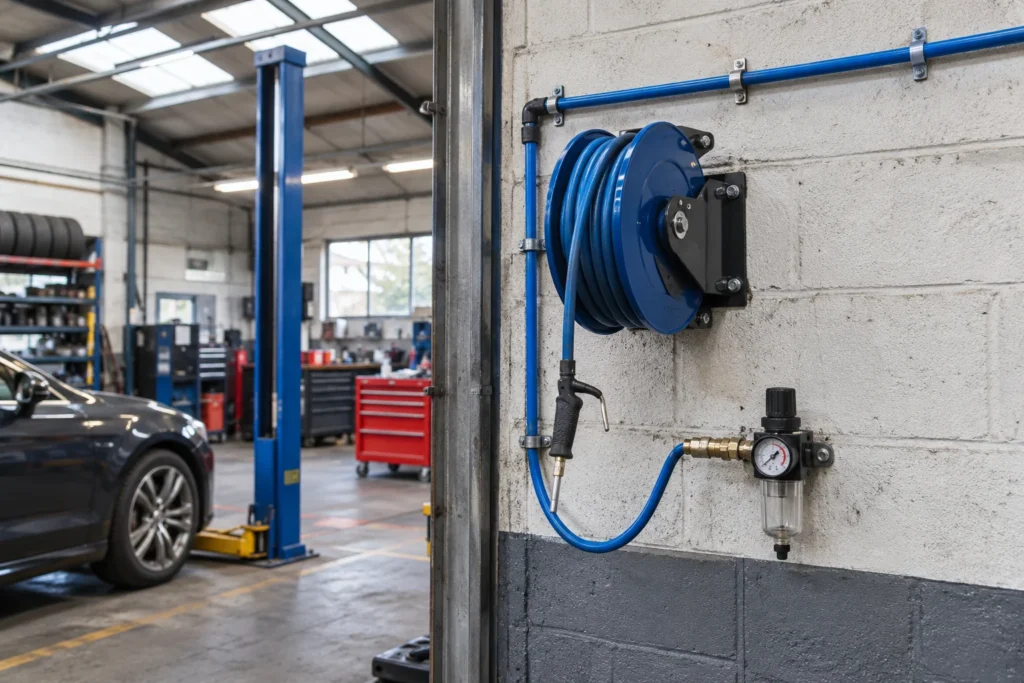
A receiver gauge can look healthy while the tool at the end of the building feels sluggish. A long hose, small couplings or a clogged filter can restrict flow. Ask the installer to check pressure under load at the tool connection as well as at the plant. A reading taken while everything is idle can miss the difference that matters. If one outlet struggles and the others are fine, start by showing the installer where and when it happens.
Put a note beside each outlet on a plan. Include the machine or tool, its required pressure and air quality, the approximate distance and the time of day it’s busiest. Allow access for isolation and servicing, and route reels where the hose can reach the work without lying across the reception door or the main route between ramps.
Source: HSE compressed-air safety guidance and layout examples
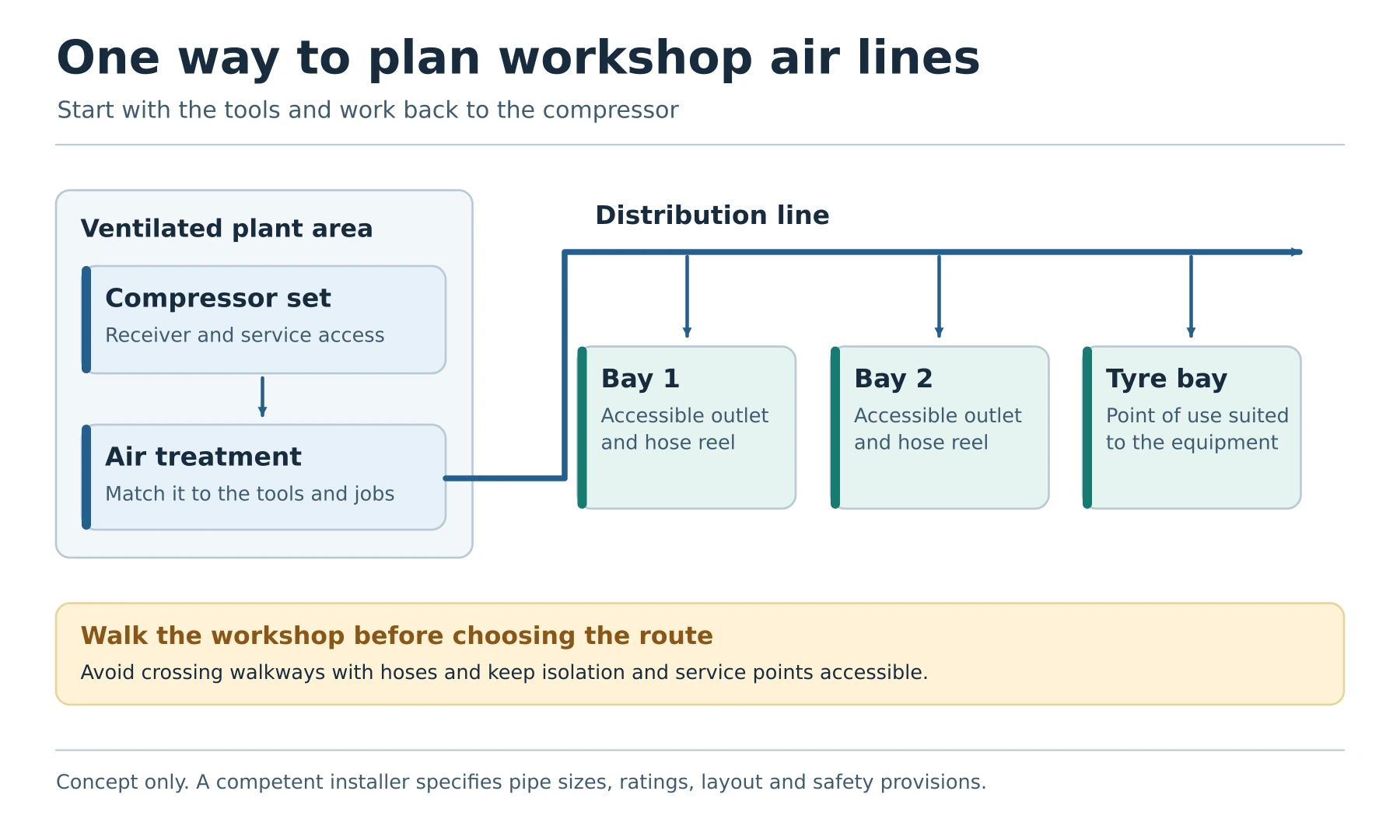
This schematic is for planning the conversation. The installer needs to specify the pipe sizes, materials, rated components, protective devices and installation for your site. A short branch can suit a small unit. A ring main gives outlets a supply route around the loop and may suit a workshop with several outlets. The layout and flow calculations determine how much difference it makes.
Agree the air quality needed for each job. General tools, paint work and specialised equipment may need different treatment. Ask what filters, drying and point-of-use regulation the supplier includes, what has to be serviced and how condensate will be handled. Put any equipment needing a different air supply on the brief before the fitter arrives.
A compressor quote needs to include more than the machine. Ask about power requirements, electrical work, noise, ventilation around the plant, air treatment, pipework, outlets, examination arrangements and access for repairs. Give the installer a photo of the proposed plant location, the building plan and your busiest tool list. Ask how long the air will be unavailable on installation day and what your options are if the system stops on a Friday afternoon.
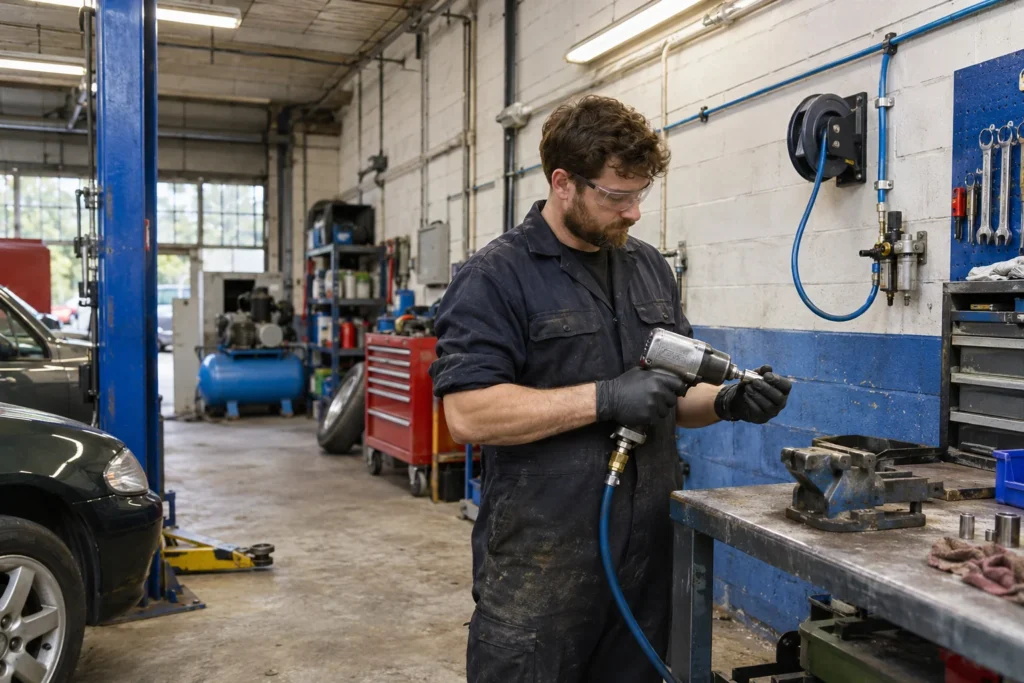
Look at running cost with some observed use. Suppose a compressor draws 2.2 kW while running under load, spends four hours a day at that draw and runs on 250 working days at 26p per kWh. That portion of consumption is 2,200 kWh, or £572 a year. If you find leaks or change the work pattern and the same loaded draw falls to two hours a day, that portion falls to 1,100 kWh, or £286. These figures leave out unloaded consumption, dryers, standing charges and maintenance. They show why it is worth measuring actual power and run time before you compare equipment or put a price on a saving. The government publishes non-domestic electricity figures for context. Use your own tariff for the calculation.
Source: DESNZ non-domestic energy prices
If the compressor frequently starts when nobody is using air, log when it happens and ask for a leak check. Repairing a fault near an outlet can be a better first investment than adding storage. If long bursts of air demand dominate the day, compare machines with the supplier on duty cycle, delivered air and whole-system running cost.
Looking at all your running costs? See how to cut garage heating and lighting costs.
Compressed air stores energy. In Great Britain, HSE says a suitable written scheme of examination must be in place and the examination carried out before qualifying pressure equipment is used. Ask a competent person to confirm how the Pressure Systems Safety Regulations apply to the actual system, including the receiver and associated equipment. Northern Ireland has its own Pressure Systems Safety Regulations and HSENI guidance. A maintenance visit and a statutory examination serve different purposes, so ask which each quote covers.
Sources: HSE Pressure Systems Safety Regulations · HSE written schemes of examination · HSENI pressure systems guidance
At handover, ask the installer to demonstrate the system under a typical busy load. Have them show staff the isolation points, normal settings and who to call if the system behaves differently. Keep the manuals and the examination and maintenance records where the workshop manager can find them. Agree what to do if a hose or reel is damaged, the system runs unusually often or an outlet starts dropping pressure.
Before you sign the quote, ask the supplier to describe your own busiest half-hour back to you. A useful answer tells you which outlets can work together, what pressure you should get at the tool and where the limits are. Those are the answers that will matter when the tyre bay and the grinder are both going at half past ten.
