Someone opens the shutter to bring in a Transit. The heat goes out, the heater comes back on and everyone spends the next ten minutes wearing their shoulders as earmuffs. Meanwhile, the lights over the empty ramp have been on since seven.
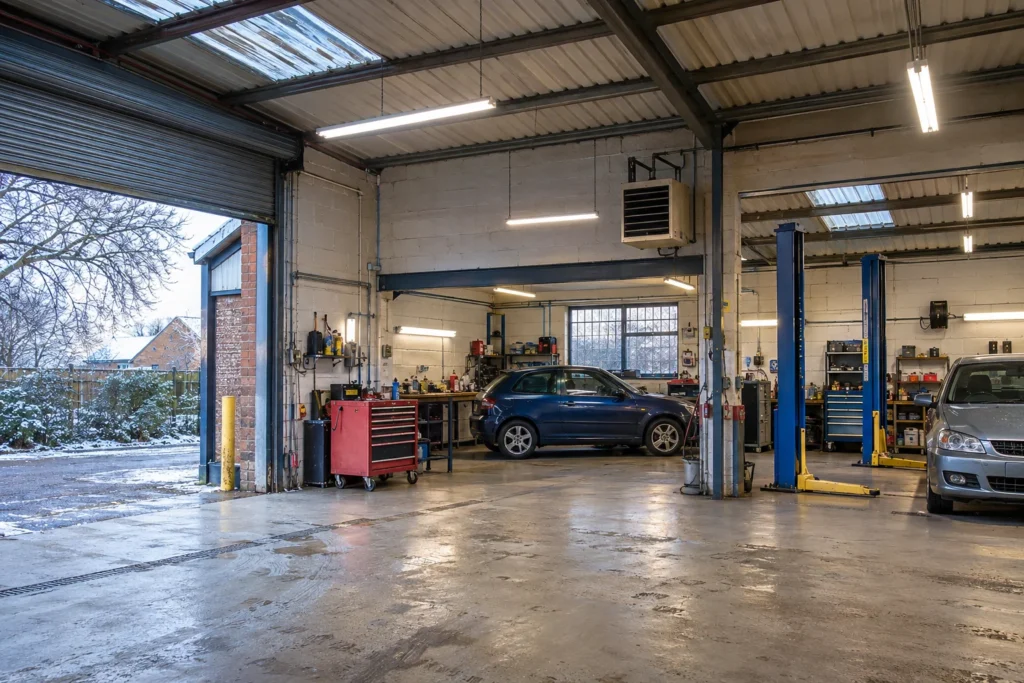
Start by finding out where you use energy and which hours you pay for it. Many garages can make a useful change by fixing a draught, changing a timer or giving each bay its own switch. Bigger jobs, such as new heating or a full LED refit, are easier to judge when you have a baseline. The aim is a lower bill and a workshop where people can see clearly, work comfortably and breathe clean air.
The Department for Energy Security and Net Zero reported average UK non-domestic prices of 24.51p per kWh for electricity and 5.28p per kWh for gas in April to June 2026, including the Climate Change Levy. These are averages across business consumers. Rates vary with consumption and contract, so use your own bill for any decision.
Source: DESNZ Quarterly Energy Prices, September 2026
Pull a recent electricity and gas bill and note the billed kWh, the unit price, any per-unit levy and the standing charge. Work on the same VAT basis throughout. The energy you avoid is worth the rate you would have paid for those units. Day-to-day savings usually leave the standing charge unchanged. Ask your supplier for half-hourly electricity data if available or take meter readings at the same times for a typical week. Compare an overnight period, a normal full day and a weekend or closed day. Even a rough pattern helps you decide whether to look first at the lights, heater or something else.
| What to record | What it helps you spot |
|---|---|
| Opening and closing times, staffed bays and shutter openings | Hours you pay to heat or light a space that’s largely empty |
| Electricity use overnight and during a busy day | Loads that keep going after closing and demand linked to working hours |
| Daily gas use and outdoor temperature where relevant | Heating changes and the effect of a colder week |
| Temperature at working height and comments from the team | Whether the cold is everywhere or concentrated by the shutter, bench or reception |
A server, alarm, emergency circuit or compressor you need for a particular process may have a good reason to stay on. Check what a load does before changing a timer or isolating anything. Look at trends rather than judging a single day when the shutter stayed open for a recovery truck.
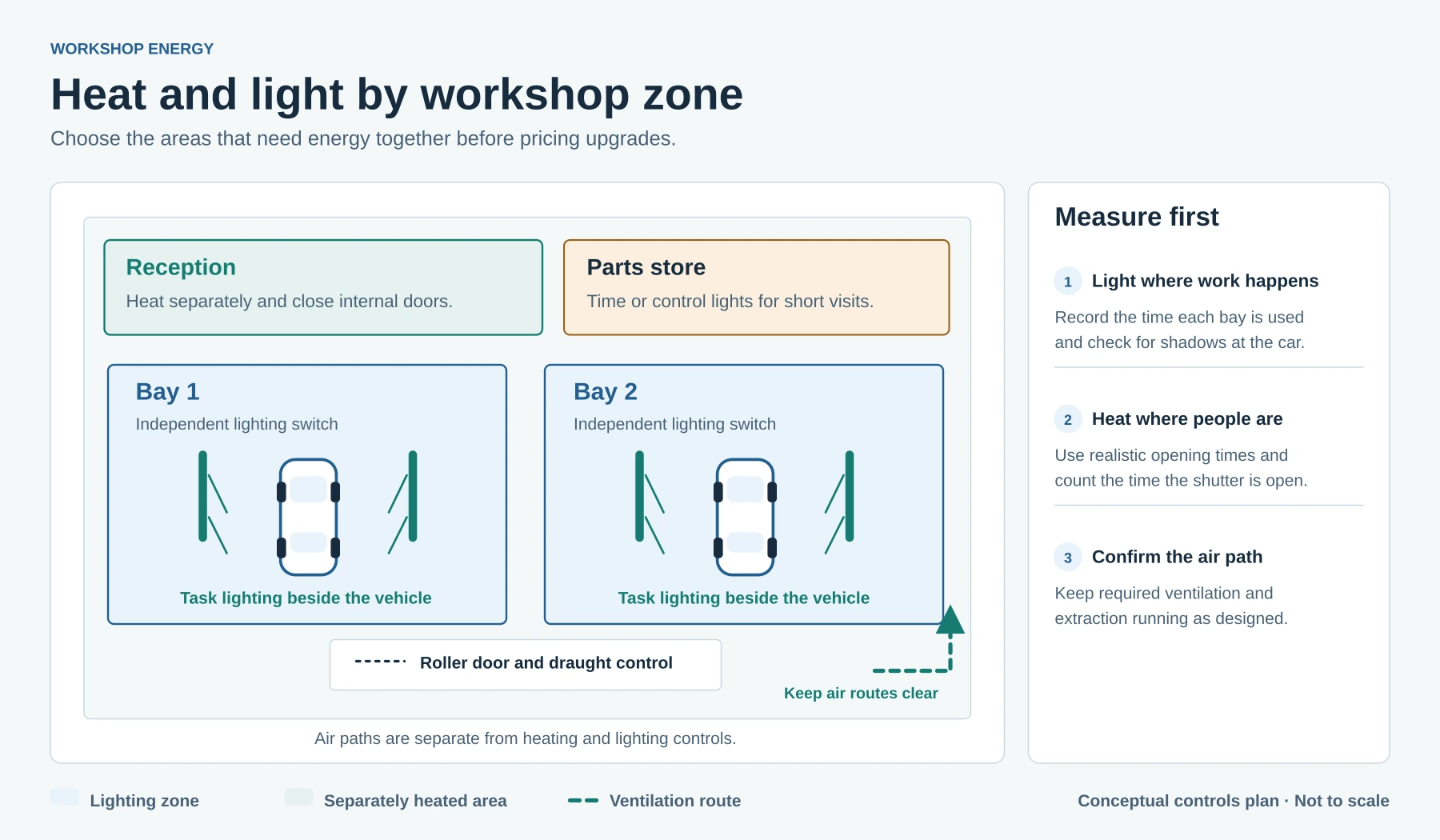
Concept sketch for planning controls. Have your installer check circuits, ventilation and heating arrangements for your actual building.
Walk the unit with the technician who opens up and whoever closes. Work out what needs light at seven, where customers sit, and which ramp gets used late. A separate reception can have its own heating schedule. Bay lights can be split so a late job on one ramp leaves the second zone off. A little-used parts store may suit automatic lighting with a suitable delay. Keep the traffic routes and exits adequately lit, including when a sensor or individual bay switch has turned off other lights.
Sources: HSE guidance on lighting vehicle routes · Energy Technology List guidance on lighting controls
Think through one awkward job before specifying controls. A technician can spend several minutes under a stationary car with little movement. A sensor that switches that bay off too soon creates a problem. Use task-appropriate detection, an override or manual zoning, and have an electrician make sure emergency lighting arrangements are preserved. Label the switches by area, and keep controls for extraction and essential safety systems clearly identified.
Look at the shutter and personnel door first. Repair worn seals through the appropriate installer. Where the site has a suitable separate entrance, stop using the roller shutter as a pedestrian door. Plan deliveries and vehicle movements so a shutter stays open for the time needed to move safely. Keep the required fresh-air supply, extraction and escape routes working. Let the ventilation designer see any proposed door or envelope changes if they could affect make-up air or exhaust discharge.
Sources: Energy Saving Trust workplace energy guide · HSE on vehicle exhaust
Start heating when the workshop needs it and check where the thermostat gets its reading. A sensor next to a cold door can behave very differently from one in the raised office above the bays. Review the timer after a shift change or holiday. Where the building is high, draughty or partitioned, ask a competent designer to compare heating the occupied area with heating the whole volume. Have them discuss radiant and warm-air options, electrical capacity and the impact of ventilation. You will learn more from a proposal that shows its assumptions than from a headline efficiency figure.
Aim for reasonable comfort where the team actually works. In Great Britain, HSE guidance says indoor workrooms should normally be at least 16°C, or 13°C where much of the work involves rigorous physical effort. The guidance calls for a risk assessment and a reasonable temperature. A service adviser sitting at a desk and a technician moving around the workshop can experience the same room differently. HSENI publishes separate workplace guidance with the same normal temperature figures.
Sources: HSE on the law and workplace temperature · HSENI temperature guidance
A timer change can be worth testing before you price a new heater. Suppose a gas heater draws an average of 12 kW during its first 45 minutes, and measurements show that the later start still keeps the occupied areas comfortable. Across 120 comparable mornings, removing that 45-minute slot would save 1,080 kWh, or about £75.60 at an illustrative unit price of 7p per kWh, if the heater uses the same amount after opening. Use the meter to check the result. A heater that runs harder to catch up later will eat into the saving.
Rented the unit? Check the lease and speak to the landlord before altering fixed lighting, roof penetrations, doors or heating. Work out who pays for the job and who benefits from the lower bill. Ask your heating contractor to check any combustion equipment and its air supply. Ventilation and temperature both belong in the brief.
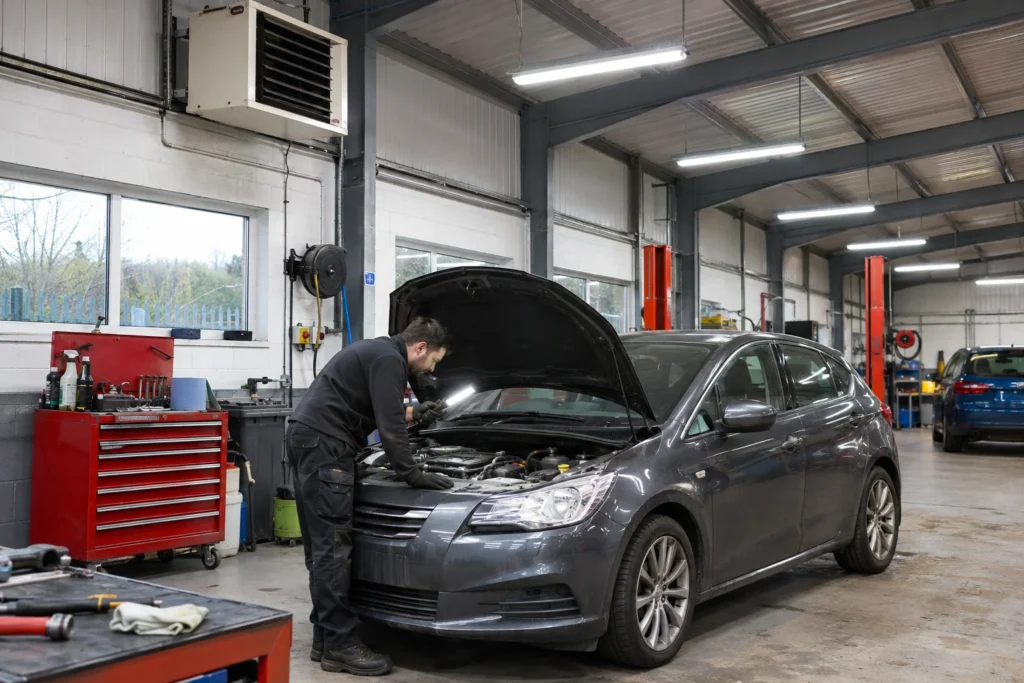
Ask the lighting supplier for the input watts per complete fitting. Compare the proposed light at the work surface, with a car on the ramp, and see whether you can read stamped numbers or spot a leak without a torch held in your teeth. Look for glare from windscreens, deep shadows around wheels and uncomfortable contrast where the bay meets a walkway. A trial bay or lighting survey is useful before replacing all the fittings.
Sources: HSE Lighting at Work · Energy Technology List efficient lighting units
Here is an illustrative two-bay example. The garage has 12 old fittings rated at 126 W each, including their gear, and prices 12 LED fittings at 54 W each. The lights run ten hours per day for 250 working days. The workshop pays 28p per kWh, and the installed quote is £1,600 on the same VAT basis as the savings.
| Lighting setup | Annual use | Annual electricity cost at 28p per kWh |
|---|---|---|
| Existing fittings at 10 hours per day | 3,780 kWh | £1,058.40 |
| LEDs at 10 hours per day | 1,620 kWh | £453.60 |
| LEDs with zoning, averaging 8.5 equivalent full-load hours per day | 1,377 kWh | £385.56 |
The refit saves £604.80 per year at the original hours, a simple payback of about 2.6 years. If the same quote includes zoning and the new operating hours hold, the saving rises to £672.84 a year and payback falls to about 2.4 years. At five hours a day for both sets of fittings, the LED-only savings fall to £302.40 a year and payback rises to about 5.3 years. Check the maths with your own hours and weigh the cost savings alongside the quality of the light your team will work under.
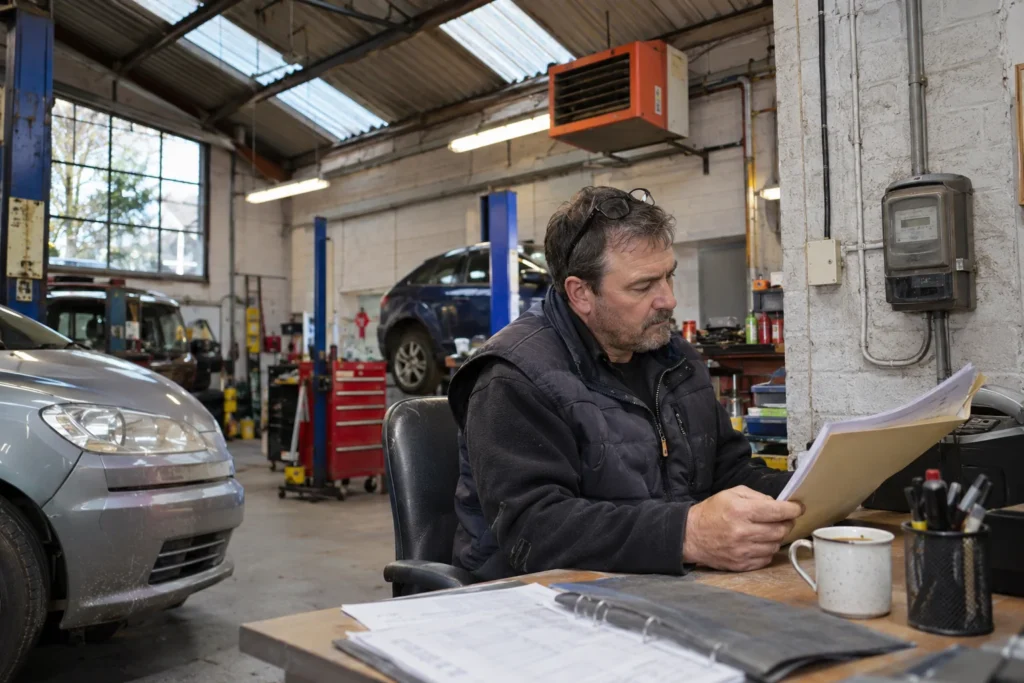
Try one manageable change for a fortnight, such as resetting the heat schedule or putting the parts store lights on their own control. Keep a simple log of meter readings, opening hours and staff feedback. For heating, compare periods with similar weather and similar working hours where you can. For lighting, see which zones actually switch off. Check that work areas, the route to the office and the yard still have suitable light, and that comfort and ventilation have held up.
Sources: Energy Saving Trust on monitoring and controls · HSE workplace facilities guidance
When you price a larger job, keep the quote, assumptions and measured savings together. That makes the next decision easier. If one bay really needs brighter light, give it brighter light. If the heater is warming an empty workshop before breakfast, give it a better schedule. The savings come from knowing which problem you’re paying to solve.
Energy is part of what every workshop hour costs. Put your new figures into the free labour rate calculator to see the effect on your rate.
