The parts van has been and gone. The box has the right registration written on it and the wrong part inside. The car is on a ramp, the customer expects it after work and another job is due through the door in an hour. What you do in the next ten minutes often matters more than how quickly you can get the supplier on the phone.
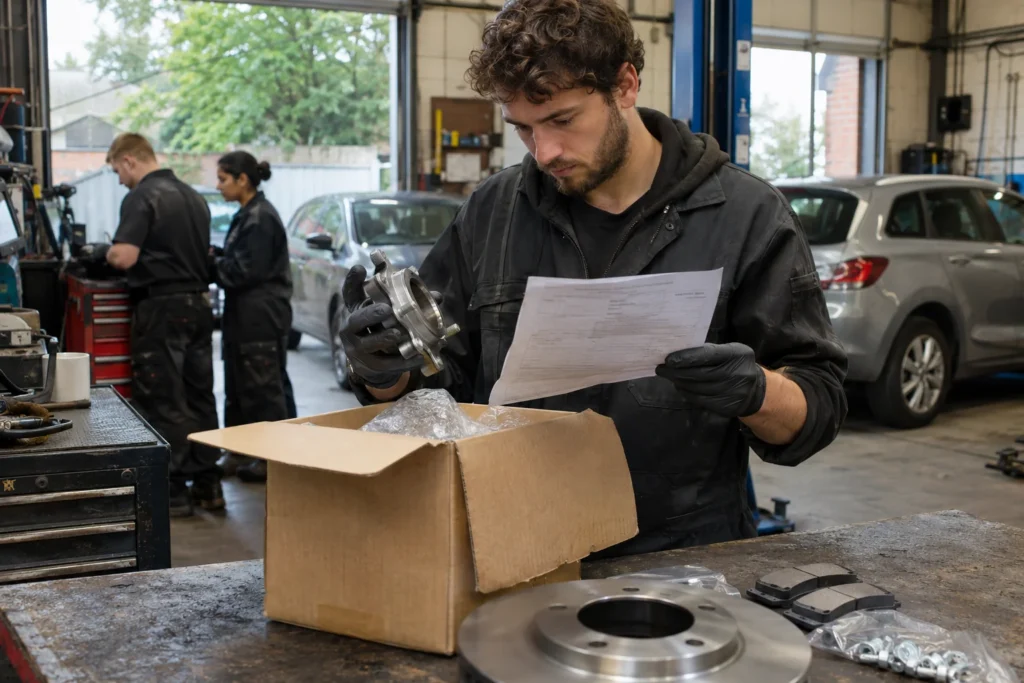
Start by finding out what is actually missing, whether the car can safely leave the bay and what time you can give the customer for an update. Each answer changes the diary.
In The Motor Ombudsman’s November 2025 survey of 85 UK independent garages and franchised workshops, 54% named parts shortages causing delays to customer vehicle repairs as one of their main operational challenges in 2025. That describes the experience of those respondents. It gives a small workshop a good reason to measure where its own jobs get stuck.
Source: The Motor Ombudsman Workshop Survey Report 2025 Review and 2026 Outlook
Check the vehicle identification number and the job details against the manufacturer information and supplier catalogue where available. A registration gets you to a list of possibilities. A model with several factory options can still need a specific variant. Where the catalogue offers several fits, ask what confirms the one you need. That might be the manufacturer’s reference, a build record or a check of the existing part by the technician. For cars that have already been repaired or modified, be ready to confirm what is actually on the vehicle.
Write the part number, quantity and supplier reference on the job. Give every related piece a check of its own. A fitting kit or the second side can be just as important to starting work as the main item. Check the delivery before the car has to go on the lift, and put confirmed parts where the technician can find them. If the correct item can only be identified after investigation, consider booking an inspect-first visit and making the repair appointment when you know what to order.
Suzuki’s UK aftersales guide uses advance parts picking and a short joint review before upcoming jobs. The independent version can be a five-minute look at tomorrow’s job cards and the boxes on your shelf. Mark what is checked on site, what is due and what still needs confirming. If you find a doubtful part at four today, you have a better chance of protecting tomorrow’s first booking.

Ask whether somebody can see the part at the branch, whether the order is waiting for a warehouse transfer, or whether it is already on a van. An expected window is useful when the next delivery depends on it. A vague promise deserves a diary entry for the next check. Record who gave the update, the order reference and when you’ll ring back.
| Supplier says | What to establish next |
|---|---|
| It’s on the van | Confirm the delivery window, the part reference and the order number. |
| It’s in stock elsewhere | Ask whether it can be reserved and when it can physically reach you. |
| It’s on back order | Ask whether there is a confirmed date or only a date to check again. |
| An alternative is available | Check fit, specification, warranty and any price or scope change before agreeing to use it. |
| The delivery was wrong | Take details of what arrived, agree the replacement and log the return so the credit can be checked. |
If you use a second supplier, check the status of the first order before you commit. Two deliveries solve one problem and create another. A UK example is LKQ’s published trade terms, which describe delivery dates in clause 13.3 as estimates and set terms for damaged or incorrectly supplied goods. Use the terms of the actual account and order in front of you.
Source: LKQ UK trade terms
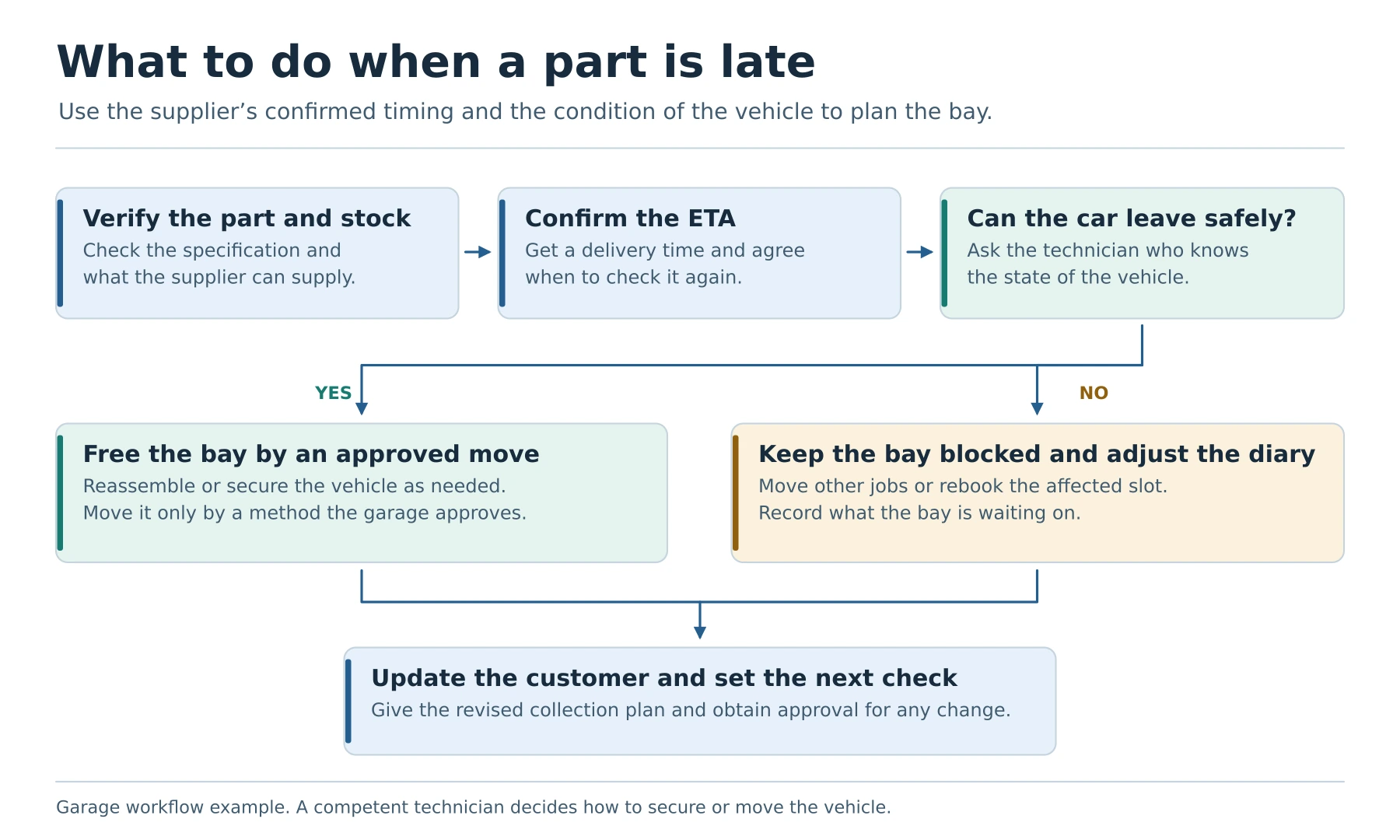
The workshop lead should make this call, with the technician who knows the state of the vehicle. If it can be made safe and moved by an approved method, identify a suitable holding space before you start. If it needs to stay on the lift, keep the ramp blocked, move the affected bookings and agree when you will review it again. Check the condition of the vehicle, the suitability of any moving equipment and the routes staff and customers will use. Treat a non-runner or a vehicle with missing safety-critical components as a separate movement decision. HSE guidance recommends keeping people apart from vehicles and reducing the need for reversing wherever possible.
Sources: HSE workshop transport guidance · HSE guidance on working under vehicles
Once it is safe to free the bay, check whether the gap can take a job that is ready. Look for one with checked parts, a willing customer, a suitable technician and enough time to finish and release the lift again. If the only candidate could overrun the expected parts delivery, keep some space or put other useful tasks in the gap.
An illustrative example has one ramp blocked from 10:00 to 13:00, with no other suitable bay free. The car can be moved safely and has a holding space. Allow a total of 30 minutes of bay and technician time to secure, move and return the car. The garage can fit a ready job into the gap that takes two hours on the ramp and two hours of technician work. That uses two and a half hours including the movement allowance, leaving half an hour of breathing room.
Assume the ready job brings in £150 of labour revenue before VAT. Allow £30 per technician hour for 2.5 hours including handling, plus £10 of other direct costs. In that example it contributes £65 before overheads, with any parts sales and costs outside this calculation. That figure shows the job’s contribution using those cost assumptions. If the job would have been completed later anyway, or the technician would have earned money on other work in the meantime, factor that into the choice. The biggest gain may be preserving tomorrow’s bookings or getting a customer back on the road sooner.
Use your own hourly cost instead of the example figure. The free labour rate calculator works it out from your wages, overheads and billable hours.

Call as soon as the original plan is in doubt. Give the customer a short explanation, what you’re doing, the next time you’ll contact them and whether they need to make a decision. If the part is due at noon, base the revised completion estimate on when you can check it, get the car back onto a suitable bay, finish the work and complete your quality checks. The part’s arrival is the start of that calculation.
Hi Maria, the part that arrived this morning is a different fit for your car. We’ve ordered the correct one and the supplier is checking when it can get here. I’ll ring you by 1 pm with an update, even if I’m still waiting for their answer. If that affects your plans for getting home, let me know and we can talk through the options.
If the revised repair changes what you are supplying or costs more than agreed, explain the change and obtain authorisation before carrying out the affected work. Log the customer’s decision and the time. For consumer contracts, the Consumer Rights Act 2015 provides for service within a reasonable time where neither the contract nor the relevant pre-contract information fixes a time. The appropriate timeframe depends on the circumstances. The Motor Ombudsman’s guidance covers delays and the expectations for businesses accredited under its Service and Repair Code.
Sources: Consumer Rights Act 2015 explanatory notes, section 52 · The Motor Ombudsman on repair delays · Service and Repair Code
For a fortnight, keep a short list of jobs put on hold. Record whether the cause was a wrong fit, a late delivery, a long back order or missing approval. Add when you found the problem, how long the ramp stayed occupied and whether the customer heard before the original collection time. Review it with reception and the workshop. One pattern will often stand out faster than you expect.
Keep the current status, the supplier or customer check time and the next action together. Garage Invoice’s Workshop Today dashboard shows jobs waiting for parts or customer approval and purchase orders due for delivery. Use the job record to add the details your team needs to decide what to do next. This afternoon’s issue is much easier to pick up tomorrow when the next person can see who was called and what happens at ten.
Read more: Garage Invoice Workshop Today dashboard
