The customer says the car makes a noise every morning. Your technician starts it at eleven, after it’s been driven across town, and it sounds fine. You’ve got a car in the yard, a job card that says “noise when driving”, and a customer expecting a repair by tea time.

Give an intermittent fault its own kind of booking. Work out when the symptom appears, check whether the car can come in safely, and sell a clearly defined first investigation. Put the customer update in the diary when you put the car in. That gives the technician a useful question to answer and reception a sensible promise to keep.
Ask the customer to tell you what they see, hear or feel. Write their description down before discussing likely causes. “Single clunk at the first left turn after an overnight park” gives the technician more to work with than “check suspension”. If somebody else normally drives the vehicle, see whether you can speak to them.
| Question to ask | What to put on the job card |
|---|---|
| What happened, and what did the warning actually say? | Exact symptom, warning text or where the sound or vibration seemed to come from |
| When did you first notice it and how often has it happened? | Date, frequency and when it last occurred |
| What was the car doing just before it happened? | Starting, accelerating, turning, braking, idling or going over a particular surface |
| What conditions seem to bring it on? | Cold or warm, wet or dry, trip length, and other relevant conditions |
| What has already been done? | Recent work, prior investigations and any relevant recovery or repair report |
| What happened next? | Whether it went away, persisted, or returned after a restart |
A short clip or a photo of a warning can help. Ask the customer to send evidence they already have or can capture safely while parked. Avoid asking them to drive again simply to produce a clip. Use your usual secure channel and keep the relevant material with the job. If there are faces, addresses or other personal details you do not need, leave them out. The UK GDPR principle of data minimisation means the personal data you collect should be adequate, relevant and limited to what you need for the purpose.
Source: ICO guidance on data minimisation
The weather can be the best clue in the booking. In a published Motor Ombudsman case, a business couldn’t reproduce intermittent rear parking sensor trouble. An independent business later identified a water leak causing a short circuit. The reported fault occurred after rain. On the next awkward booking, putting “after heavy rain” at the top of the job card could give the technician a better place to start.
If the driver reports a loss of braking or steering, a serious warning, stalling in traffic or another symptom that raises doubts about safe use, get a competent person to assess how the vehicle should reach you. Advise the driver to stop safely if appropriate and discuss recovery or another suitable arrangement. A phone description can start the assessment. A decision about driving needs enough evidence to support it. GOV.UK says the vehicle must remain roadworthy even with a current MOT. Northern Ireland publishes its own roadworthiness guidance.
Sources: GOV.UK vehicle safety guidance · nidirect vehicle safety guidance
Choose the appointment around the trigger. For a cold-only symptom, agree an overnight drop-off, space to park the car and a first-start slot for the technician. For a fault that only appears after longer journeys, the technician might begin with history, static checks and the conditions under which a suitable test would be useful. A moving test needs its own safety and legal checks. Leave time for the conditions a vehicle needs and tell the customer when you’ll have something useful to report.
Source: HSE on planning work journeys
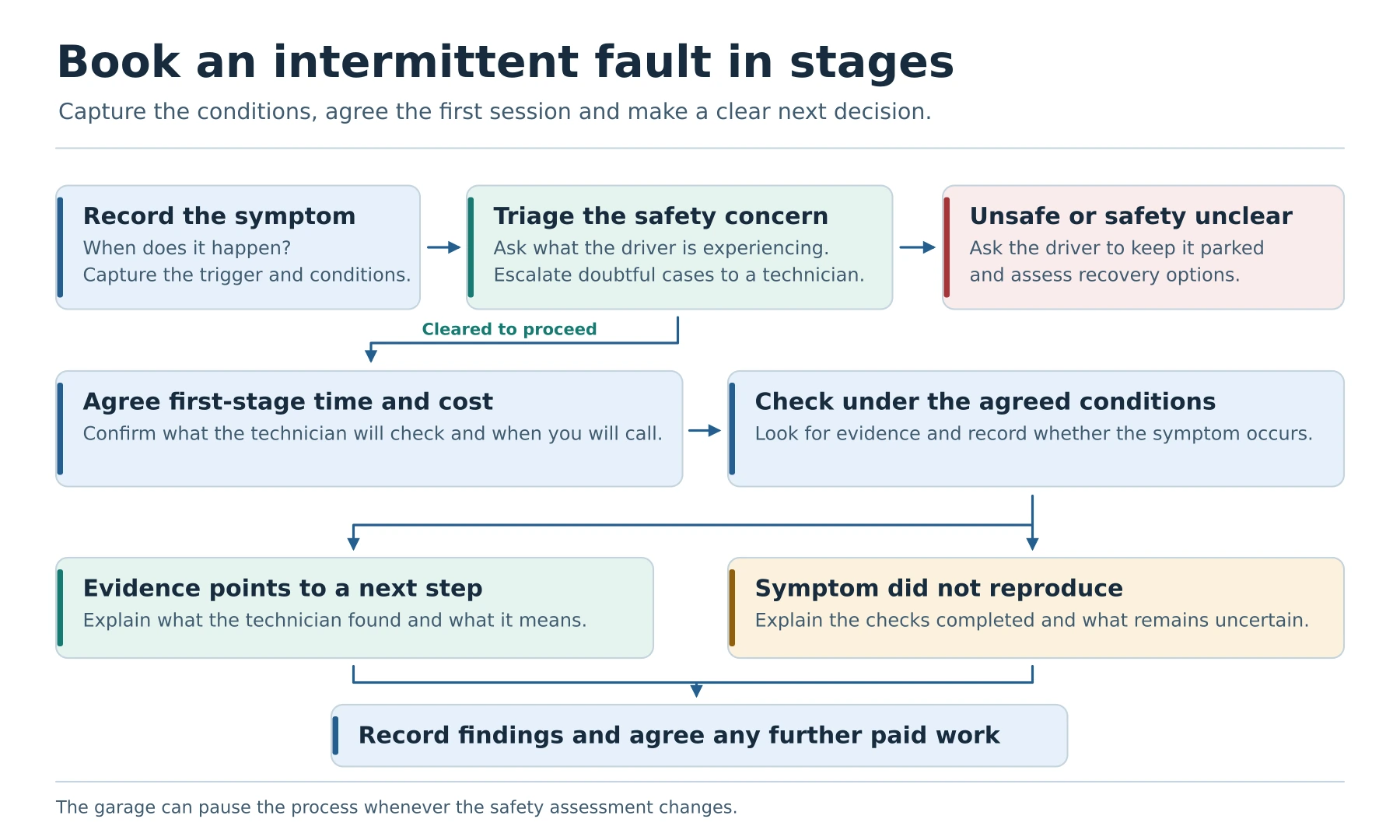

Say what the customer is buying. A first stage might include listening to the symptom history, checking available data, doing relevant checks and providing a short written finding with a recommended next step. Agree how much time you’ll spend, the price including VAT where applicable and when you’ll call. Explain the possibility that the symptom will stay quiet during the session. The Motor Ombudsman’s Service and Repair Code requires accredited businesses to agree diagnostic charging terms at booking and get approval for extra work before starting it. Consumer services are subject to the statutory duty to exercise reasonable care and skill.
Sources: Service and Repair Code, sections 2.4 and 3.2 · Consumer Rights Act 2015, section 49
Published charges give a sense of how garages describe the offer. Prices checked in November 2026 included £114 including VAT for up to an hour at Autodiag in Rugby and £108 including VAT for the first hour of electrical diagnostic testing at Walton Bridge Garage in Shepperton. The two businesses describe their own packages. Work out what yours includes and how much it costs to deliver.
Sources: Autodiag diagnostic fees · Walton Bridge Garage pricing
Here’s wording for an illustrative booking. Change the offer to reflect your own terms.
We can book up to 45 minutes of initial investigation for a fixed £90 including VAT. That covers checking the symptom and giving you our findings. An intermittent fault may stay quiet while it’s here. We’ll call by 11 with what we’ve found and ask you before doing any further chargeable work.
Keep the authorisation on the job, with the scope and amount. A diagnostic code can give the technician a lead to check. Record what the checks support before you recommend a part. In another published Motor Ombudsman case, a second garage reached a diagnosis after the fault returned. The first garage’s fee remained in place after the evidence was assessed against the investigation it carried out. Keep a useful record even when the car behaves itself.
Source: Motor Ombudsman dashboard warning-light case
The free free job card template keeps the reported symptom, the work agreed and the findings together.
In this example, a customer hears a short rattle only at the first start of the day. The workshop assesses the initial report and agrees a safe way for the customer to leave the car the evening before. Reception records the description, when it last happened and what recent work was done. The technician gets the first slot and has the agreed 45 minutes. The customer gets an 11 am update whether or not the fault has appeared.
| Diary entry | Illustrative allowance |
|---|---|
| Drop-off and written brief | 10 minutes of adviser time, previous evening |
| First investigation while the car is cold | Up to 45 minutes of technician time |
| Record the result and call the customer | 10 minutes of adviser time |
| Extra investigation | Separate booking after approval |
The first stage has £90 of authorised work. If the next useful test needs a 30-minute session priced at an additional £60 including VAT, the total would be £150 once the customer agrees. Book the extra 30 minutes once you have their approval, including a new update time. If the fault has already been captured, use the call to explain what the evidence supports and what it would cost to investigate or repair next.
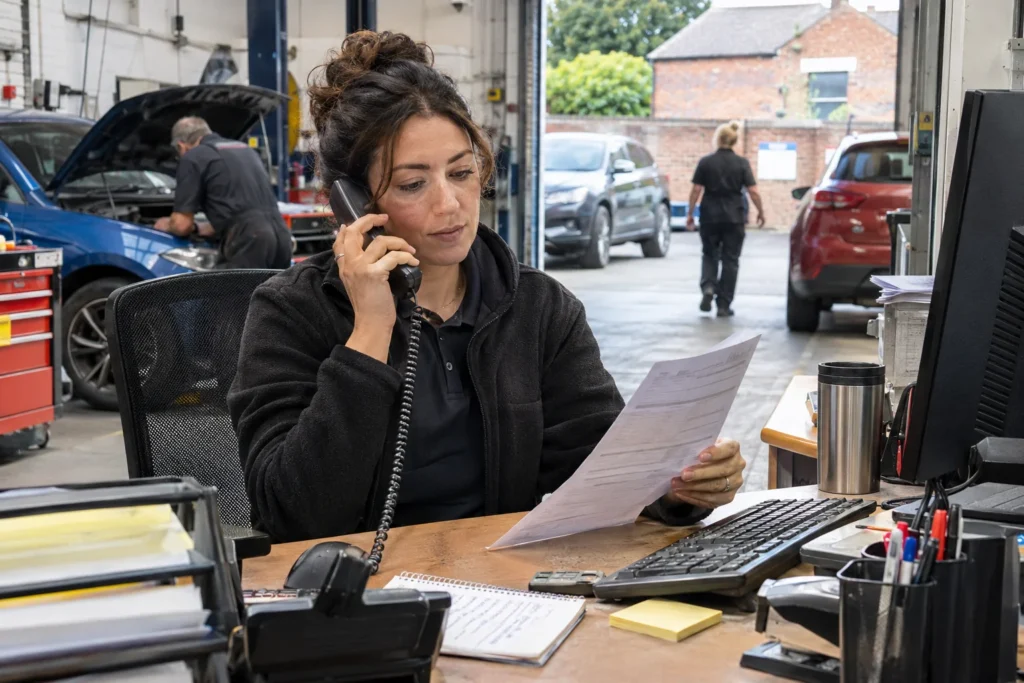
Write down the conditions, tests, observations and any limitations. Give the customer the shortest accurate version of that record. If safety remains uncertain, say so directly and discuss suitable arrangements. Where the assessment supports collection, explain what evidence would help if the issue returns. Mention the contact name or number so the customer doesn’t have to give the whole story again.
We checked the car on its first start this morning and carried out the agreed checks. The rattle didn’t occur during the session. We’ve recorded the conditions and what we checked. If it returns, let us know how long the car had been parked and what happened. We can then discuss the next useful test and confirm the cost before booking it.
Use the same job card for the original description, approved stage and technician findings. A follow-up visit can start with last time’s evidence instead of another blank screen. The next time reception hears “it only does it sometimes”, make the first question “when did you last notice it?”
Read more: Garage Invoice job card guide
