A lift earns its keep one job at a time. Choose it for the work you do every week, the largest vehicles you actually accept and the space you can use once a car is on it. A two-post lift may give a general repair garage the access it wants. A four-post lift can make sense for more drive-on work. A scissor lift can help a busy wheel bay use its floor space well.
Start with your own job cards. A catalogue can tell you the lift’s rated capacity. Last month’s diary can tell you whether it would have helped on the jobs you were paid to do.
Go through a month of completed jobs and list the work you would put on the new lift. Divide it into jobs that need the wheels free, jobs that need the vehicle sitting on its wheels, and jobs that need long stretches of clear access underneath. Record the vehicles that arrived as well as the ones you had to send away.
Check the heaviest and longest models on that list. Write down relevant vehicle weights, wheelbase, track width and manufacturer-approved lifting points. For two-post lifts, the supplier must also check arm reach and load distribution for the vehicles you’re planning to lift. For drive-on lifts, check runway length, approach and the equipment needed to let the wheels hang free. The UK had 4,951,370 licensed light goods vehicles at the end of June 2026. If you’re buying with vans in mind, take your own frequently booked van models to the supplier. Payload, fitted equipment and vehicle dimensions can matter as much as the badge on the back.
Sources: DfT vehicle licensing statistics for April to June 2026 · HSE two-post lift guidance
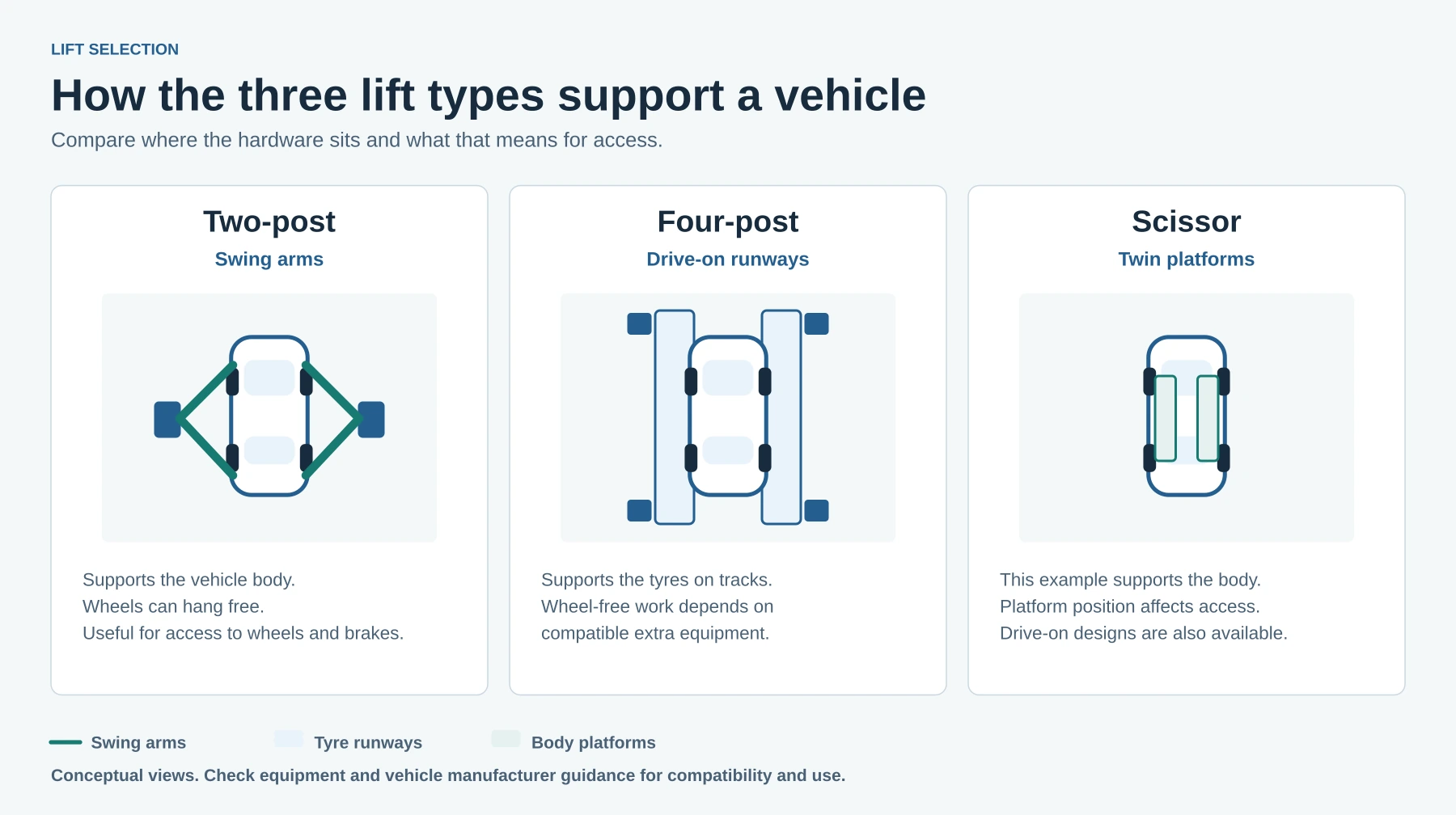
The diagram shows how the lift types support a vehicle. Installation dimensions and compatible vehicles come from the specific lift manufacturer and a competent installer.
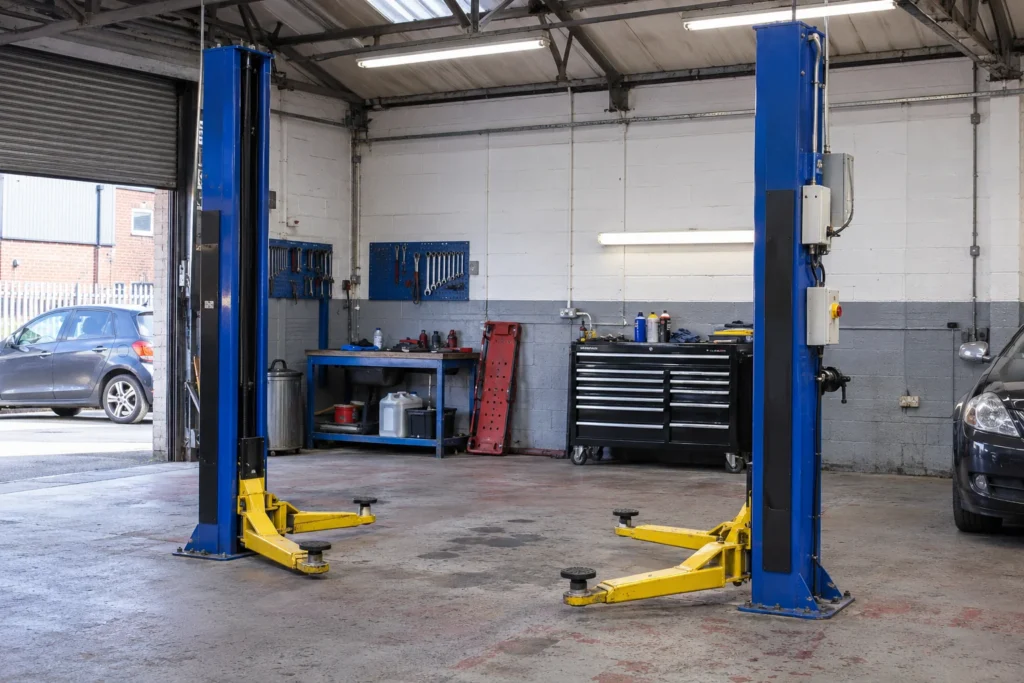
Two columns support swing arms positioned at approved vehicle lifting points. The wheels normally hang free, and an appropriate model can leave useful access to the underside. That suits much of the mix in a general mechanical workshop, including brakes, suspension and some drivetrain work.
The arms have to reach the right points on everything you plan to lift. Try the actual van, low car or unusual wheelbase you see often, with the supplier present if possible. Side clearance also matters. If a post prevents you opening a door far enough to get out comfortably, you’ll meet that problem every time the bay is used. Compare a floor-plate design with a clear-floor option if you regularly roll workshop equipment between the posts. Check the overhead structure on a clear-floor model, too.
HSE highlights correct pad placement, arm locks and the effect of removing heavy parts on the vehicle’s stability. Put the operation and training in the budget alongside the installation.
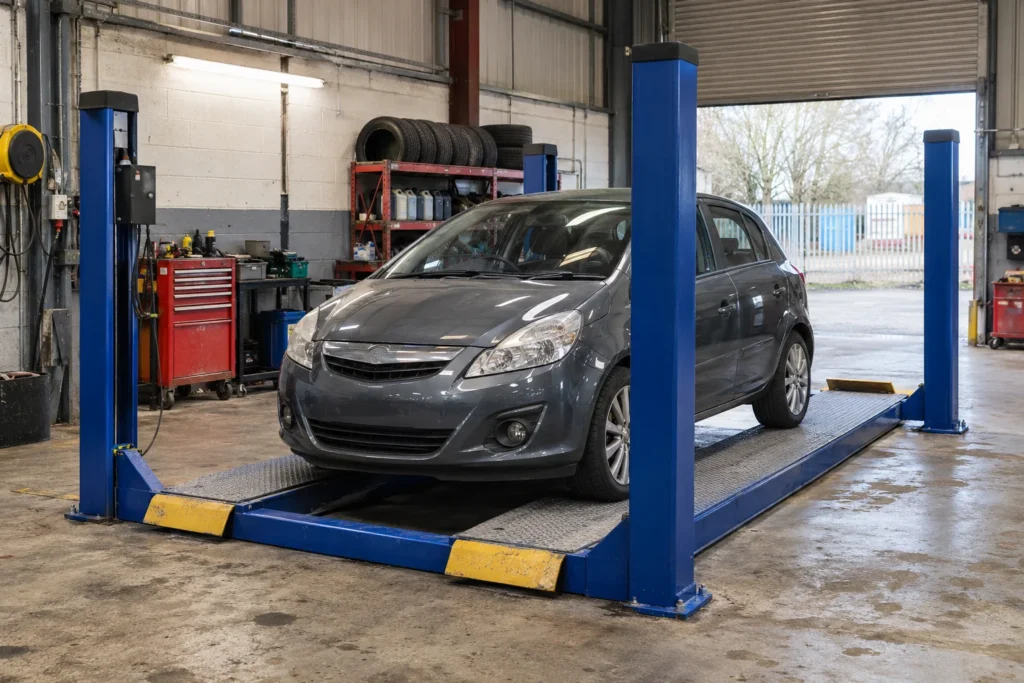
A vehicle drives onto runways and sits on its wheels. That can suit inspection work and some alignment setups. For wheel-free jobs, ask what compatible jacking equipment the lift uses and exactly what the quote includes. If alignment is the reason for the purchase, confirm that the lift, turnplates, slip plates and measuring equipment will work together on the vehicles you expect to see.
Look beyond the length of the runways. Allow for driving on, getting off and bringing the next vehicle around. Ask the supplier to show the whole footprint, including drive-on ramps and the working area around them. The garage that could just fit a long platform against the back wall still needs room to load a vehicle onto it.
If you want to use the bay for MOT testing in Great Britain, check DVSA requirements for the vehicle classes, premises and approved equipment before ordering. Treat workshop suitability and approval for MOT testing as two separate checks.
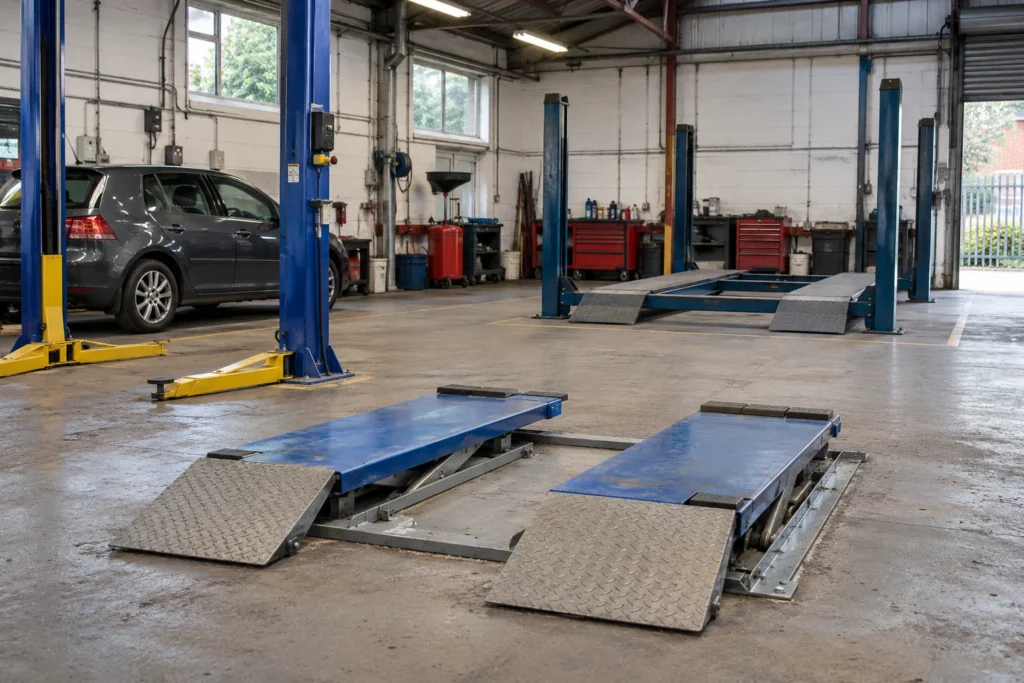
Scissor lifts come in different heights and layouts. A mid-rise, frame-contact model may suit jobs done around the wheels. A full-rise model is a different proposition if technicians need standing access underneath. Ask where the platforms and mechanism sit with the vehicle raised. They can affect access to the very component you bought the lift to reach.
Some lifts sit on the surface. Others are designed to be recessed so the bay floor is flatter when the lift is down. A flush finish may involve floor work, drainage or a landlord’s permission. Look at the cost and downtime of that work, and ask how the vehicle will drive onto the platform when the lift is lowered. Check the supplier’s drawings against equipment such as a transmission jack or a battery handling table if you use one.
These are prices displayed by one UK supplier and checked in November 2026. Ask the supplier to confirm VAT, delivery, fitting and any options. Each model illustrates a type of lift.
| Lift on the supplier’s site | Displayed price | A detail to check |
|---|---|---|
| Automotech AS-6140D, 4.0 t two-post | £1,650 | Listed lifting height of 1,900 mm. Check arm reach and how the model sits in the bay. |
| Automotech AS-6745P, 4.2 t four-post | £3,450 | Listed runway length of 4,800 mm, with a rolling jacking beam included. |
| Automotech AS-7532B, 3.2 t mid-rise scissor | £1,995 | Surface-mounted with a listed lifting height of 1,000 mm. It illustrates a mid-rise configuration. |
Automotech two-post listing · Automotech four-post listing · Automotech mid-rise listing
Say you have illustrative installed quotes of £3,050 for a suitable general repair lift and £10,250 for a four-post setup with the alignment equipment your garage would need. The second option costs £7,200 more, before VAT on a consistent basis. Use an actual quote for your own site and allow separately for any work the investment displaces.
Suppose keeping an alignment job in-house leaves £30 more than sending it out, after technician time and the other direct costs. At that figure, the £7,200 difference takes 240 paid alignments to recover. At four a month that’s 60 months. At twelve it’s 20 months. Those are simple payback figures before finance, equipment upkeep and any lost bay time. A month’s worth of repair orders and referral invoices will give you a better starting point than the number of cars you hope to see after you buy the lift.
Give the installer a measured drawing with the lowest obstruction, door travel, floor details, sockets and electrical supply. Include the approach to the bay and the space needed to move equipment around a raised vehicle. Send the largest vehicle examples and ask the installer to confirm which configurations the lift can handle. They may also need evidence of the slab’s construction and strength. HSE advises competent installation and expert assessment where the floor specification is uncertain. Use the floor and fixing specification for the exact model you plan to install.
Sources: HSE guidance on installation and anchoring · Garage Equipment Association buyer guidance
Have the supplier split the quote into purchase, ground preparation, electrical work, delivery, installation and commissioning. Confirm operator instruction, maintenance support, spare parts and who arranges the thorough examination where required before first use. HSE recommends a competent-person thorough examination of vehicle lifts every six months. Keep your checks and maintenance in the plan as well. Northern Ireland garages can refer to HSENI’s motor vehicle repair guidance.
Sources: HSE working under vehicles · HSE LOLER overview · HSENI motor vehicle repair guidance
Give each shortlisted lift three jobs from your own diary. Ask the supplier to walk through how those cars go on, where the technician works and how the next booking gets into the bay. Once those jobs and the site checks line up, compare the installed quotes.
Fitting a lift into an existing unit? See how to design a small workshop floor plan to check the routes around it.
