A van is in for an intermittent fault. The mechanic needs the engine running, it is cold outside and the nearest shutter is shut. That is a normal workshop day. It’s also the day your exhaust extraction setup needs to work.
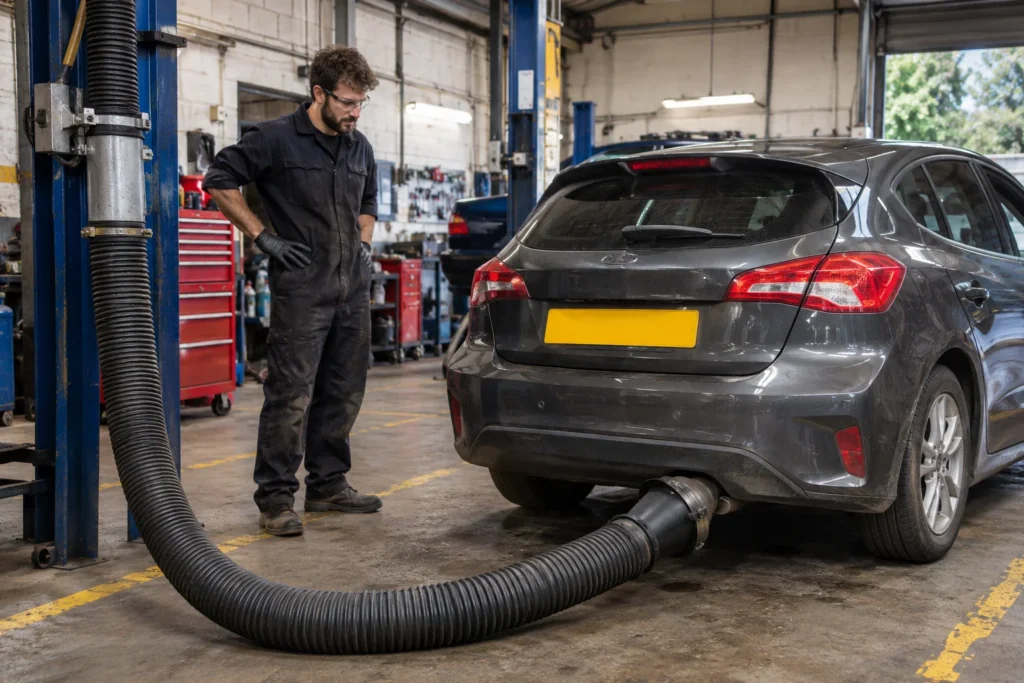
Where you can avoid running an engine indoors, plan the job that way. Where a stationary engine does need to run, HSE’s motor repair guidance calls for a tailpipe exhaust scavenger, especially around an inspection pit. Make source capture easy to use, provide fresh air for the occupied space, and get a competent specialist to design and commission the system for your vehicles and work.
Sources: HSE guidance on vehicle exhaust emissions · HSE COSHH guide SR14
Petrol, diesel and other carbon-fuelled engines can produce carbon monoxide. Exhaust can irritate the eyes and airways, and repeated exposure to diesel exhaust can increase the risk of lung cancer. Concentrations can rise quickly indoors, including when cold engines are started intermittently. Smell and visible smoke are poor ways to judge control. A catalytic converter is particularly unreliable as a control when the exhaust is cool, and HSE says garages should avoid relying on an open access door for ventilation.
Sources: HSE guidance on exhaust emissions · HSE guidance on diesel engine exhaust
Walk a few days’ jobs with the team and write down actual engine-running tasks before asking for prices. A single service bay where a car runs briefly presents different questions from a two-bay shop with simultaneous tests and vans. Note the locations people work, where a customer waits and what happens when the shutter is closed. Include diesel particulate filter regeneration or higher-load testing if you intend to offer it. Ask the specialist to assess high-temperature or high-flow work separately and confirm the system’s limits. Use a capable site or refer the work while suitable controls are unavailable.
| What to record | Why it matters |
|---|---|
| Types of engine, vehicle size and each tailpipe position | The nozzle and hose have to fit the vehicles and reach them in their working positions |
| How long each task runs and whether it runs under load | Temperature and exhaust flow affect the equipment specification |
| Bays that can run at the same time and any pit | The design and tests need to cover real combinations of work |
| Doors, windows, air intakes and nearby occupied spaces | Clean air needs a way in and exhaust needs a safe way out |
| Bay, reception and pedestrian routes | The layout and working rules must protect mechanics, colleagues, visitors and people outside |
Moving vehicles also release fume when no tailpipe connection is in use. Include vehicle movements, idling and the general ventilation arrangement in the assessment. Where practical, organise work so engines can switch off as soon as the vehicle stops moving. Keep people clear of bays where testing is underway unless their work requires them to be there.
Source: HSE COSHH guides SR14 and SR15
Planning bays from scratch? See how to design a small workshop floor plan.
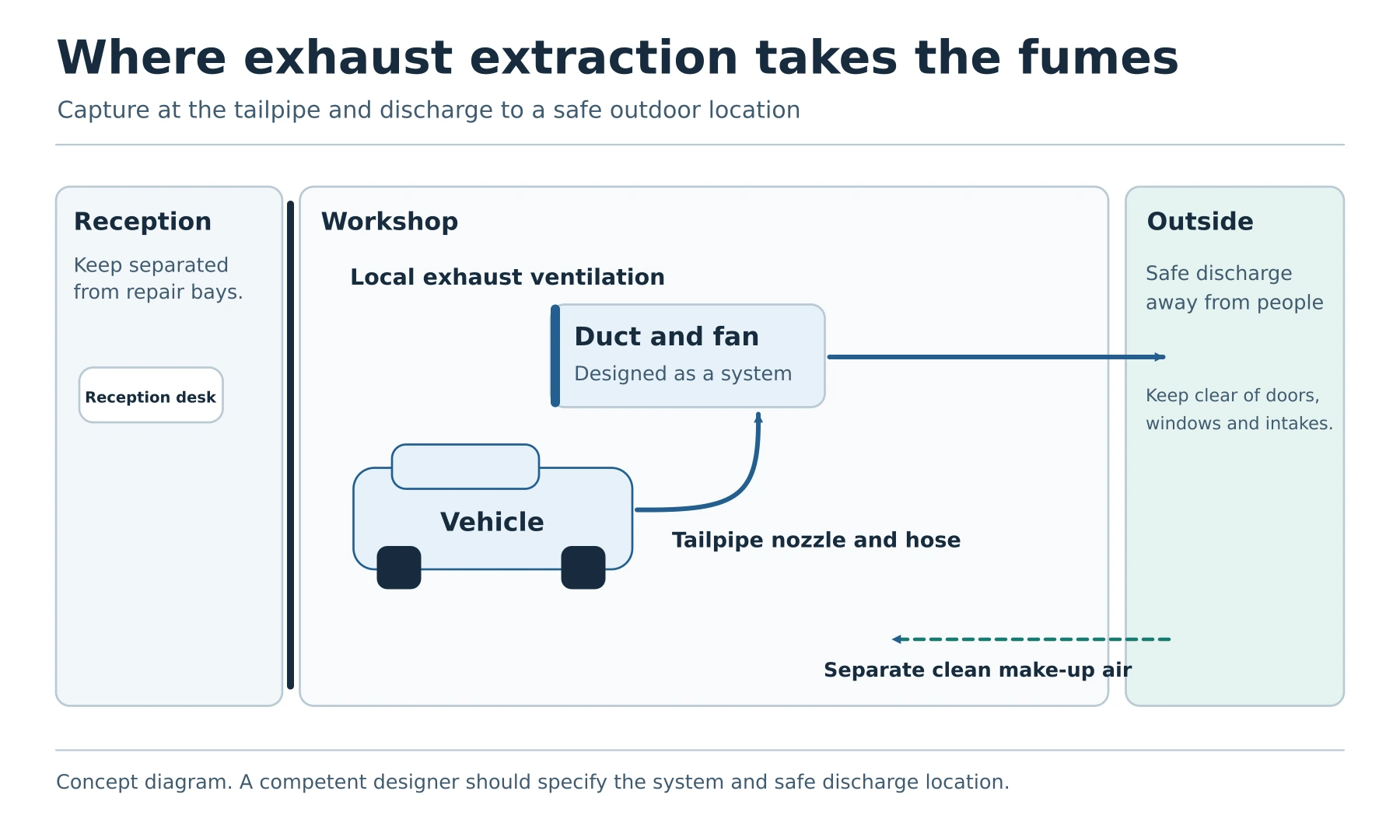
Concept only. Have a competent designer specify the equipment, airflow and discharge location for the premises.
An exhaust scavenging system collects fumes at the tailpipe using a suitable connection or pickup. The system carries the fumes through a hose and ductwork to a safe discharge outdoors. The designer needs to consider doors, windows, air inlets, neighbours, footpaths and where staff and customers stand. A short duct run might look attractive on a quote. Check where it ends with the same care. Check landlord permission, building requirements and any potential impacts of the discharge before drilling through a wall or roof.
Sources: HSE on vehicle exhaust discharge · HSE guide to local exhaust ventilation
General ventilation brings a sufficient supply of clean air to occupied spaces and helps manage fumes from vehicle movements and other assessed activities. Tailpipe extraction is the control at the source for static work. Both have their place. Make-up air has to come from somewhere suitable when the fan extracts air. Ask the designer to check that performance holds with the shutters in their normal positions, with other equipment running and with every outlet required for the work in use. A circulation fan simply moves workshop air around. The extracted exhaust gases need a safe route outdoors.
Sources: HSE diesel engine exhaust guidance · HSE commissioning guidance
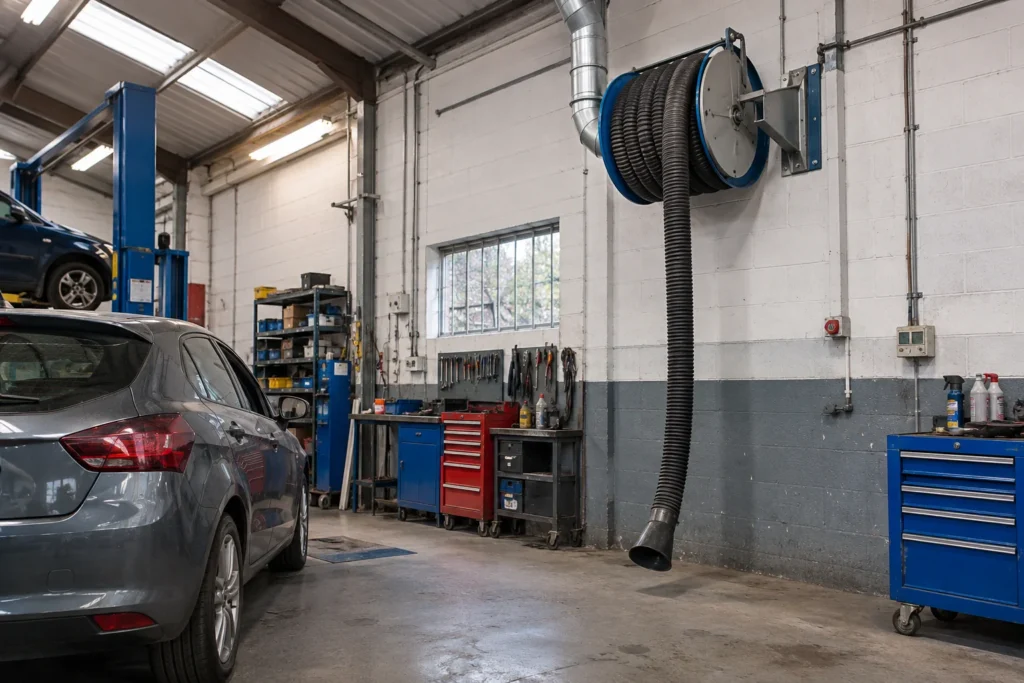
A fixed hose assembly or retractable reel usually gives a dedicated bay a predictable place to connect. A rail or shared duct system can suit a workshop using several vehicle positions. For a movable unit, ask how the system safely discharges outside from each working location and how staff check that it is performing correctly. Walk the hose route with a trolley and look at it with a vehicle on the ramp. Confirm who will provide compatible adapters for awkward or paired tailpipes, and check where a hot hose will rest when a job finishes.
Source: HSE diesel engine exhaust guidance, including system illustrations
As a UK price check on 15 November 2026, Welding & Welder listed one manual Nederman single-vehicle extractor variant at £796.48 excluding VAT as extractor only. The variant with a fan and nozzle was £1,539.88 excluding VAT. Those are online equipment prices for particular variants. The design, installation, power supply, suitable discharge, commissioning and any fresh-air alterations depend on the premises.
Source: Welding & Welder listing and variant prices
For a simple comparison, suppose a contractor specifies a single-bay kit at around £1,540 and your illustrative allowances are £550 for fitting and electrical work, £325 for duct and discharge work, and £275 for commissioning. That gives £2,690 before VAT. Allow £225 a year for planned checks and maintenance in this example. If the fan uses 0.75 kW for two hours per day, 250 days per year, at 28p per kWh, power adds about £105 per year. The three-year planning total comes to £3,680 before VAT, using those assumptions. Ask for a site quotation and obtain the actual maintenance and testing schedule. Your budget line and the statutory examination interval serve different purposes.
Commissioning checks how the installed system controls exposure and establishes figures to use as a benchmark. Require a report for the conditions you expect to operate in, with the configuration, airflow or pressure measurements as appropriate, checks at the hoods or connections used, and any limitations. Ask for a manual, an accessible performance indicator or agreed pre-use check, a logbook and a demonstration before relying on the system. Find out what the displayed reading means and what staff should do if the check fails.
Source: HSE on commissioning local exhaust ventilation
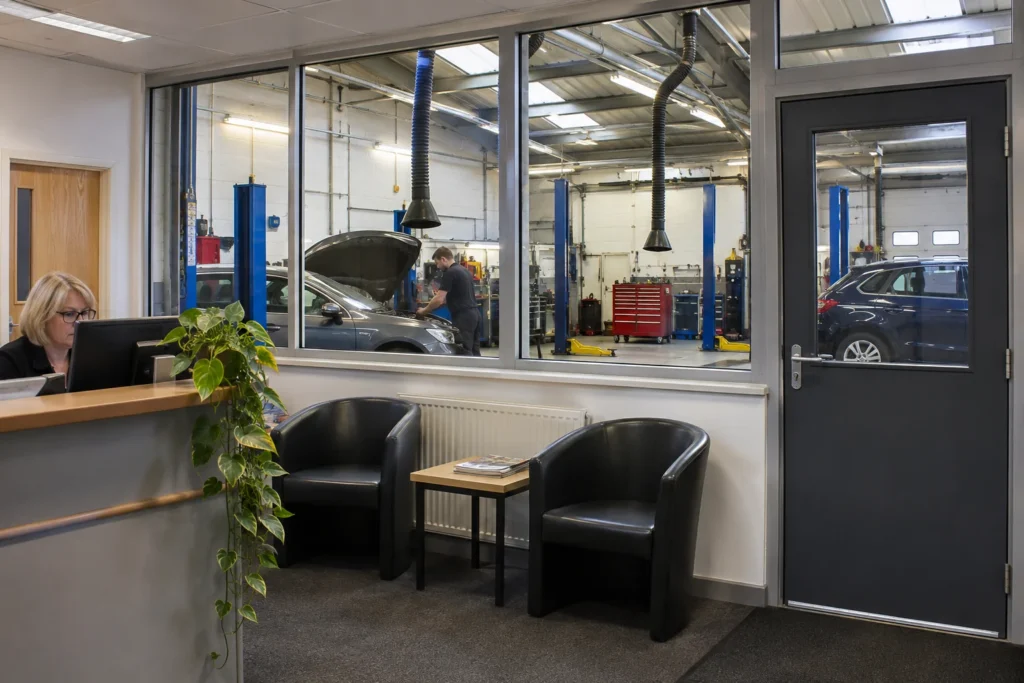
Make the start-up routine obvious. In the assigned bay, use the suitable nozzle, check the hose and connection, and switch on and confirm the extraction before starting the stationary engine. Follow the system instructions for disconnection and shutdown. If the indicator is out of range, the hose leaks or the fan fails, stop the static run safely and take that equipment out of use until the fault has been resolved. Keep customers away from the work area and include the separation from reception and the outside approach in the risk assessment.
Source: HSE COSHH guidance on vehicle exhaust fumes
Have a competent person thoroughly examine and test the extraction system on the appropriate schedule. For this type of local exhaust ventilation in Great Britain, HSE guidance calls for at least every 14 months, with more frequent testing where needed. Keep the examination and test records for at least five years. Routine checks, cleaning and repairs continue in between. In Northern Ireland, check the separate COSHH requirements and HSENI guidance. Reassess when you add a bay, move a discharge, change the building’s ventilation or take on a process outside the original design.
Sources: HSE LEV questions and record-keeping guidance · HSENI local exhaust ventilation guidance
The best time to find a hose that won’t reach, a nozzle that doesn’t fit or an awkward switch is on a walk-through with the team and the installer. Give the people who use it a say before you sign off the job. They’ll spot the everyday reasons a system might get bypassed, and you can fix those before the first cold Monday.
