A customer books an MOT and a service, then asks why VAT appears on one line of the invoice and nothing appears on the other. The answer depends on who supplied the MOT, how you arranged it, and what else you charged for.
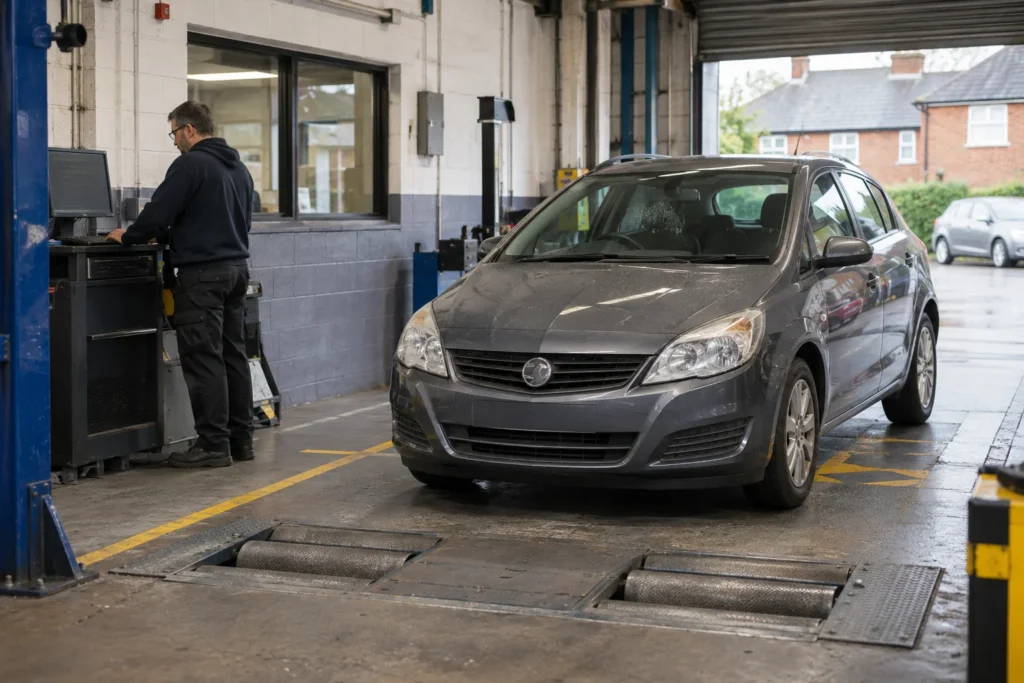
An approved centre that supplies an MOT directly to the customer treats the statutory test fee as outside the scope of VAT, up to the relevant fee cap. A VAT-registered garage that sends a car to another test centre may be able to pass on the exact test fee as a disbursement. Its own arranging fee, servicing and repairs are generally standard-rated. The Great Britain examples below show how those rules look on an invoice.
Sources: HMRC guidance on MOT test fees · GOV.UK on charging VAT
In England, Scotland and Wales, the maximum fee for a standard Class 4 car MOT is £54.85. A standard solo motorcycle test is capped at £29.65. The cap varies by vehicle type and larger vans can be in a different class. A test centre can charge below the cap and the fee for a qualifying direct test remains outside the scope of VAT. Check the class before copying last year’s price list.
Sources: GOV.UK MOT fees by vehicle type · DVSA guide to test fees
Put the statutory test and the work you carried out on separate invoice lines. In this example, an approved, VAT-registered centre charges £50 for the MOT and £150 before VAT for a service. The MOT accounts for £50 of the final bill and the service accounts for £180.
| Invoice line | Charge before VAT | VAT | Customer pays |
|---|---|---|---|
| Class 4 MOT at the approved centre | £50.00 | Outside scope | £50.00 |
| Vehicle service | £150.00 | £30.00 | £180.00 |
| Total | £200.00 | £30.00 | £230.00 |
The same distinction matters when a car fails. A replacement tyre or work on the brakes is repair work. Apply the correct rate to that work and check the retest terms separately. For example, DVSA allows a free partial retest in Great Britain when the car stays at the original test station for repairs and is retested within ten working days. If the car leaves and comes back, check the return date and what it failed on to see which retest terms apply.
Source: GOV.UK rules on MOT retests
Suppose your equipment breaks down or you’re short of a tester, and another approved test centre carries out the test for you. HMRC says the original approved centre can still be supplying the MOT to its customer. Under that operational subcontracting arrangement, the test remains outside the scope of VAT up to the statutory maximum, even if the second centre gives you a discount. Work out which business is supplying the test to the customer when the agreement is made.
Source: HMRC guidance on approved centres subcontracting MOTs
A disbursement is a payment your garage makes on the customer’s behalf, then recovers from the customer. For an MOT, that can mean your customer receives a test supplied by the approved station, while you arrange the appointment and pay the station for them.
HMRC requires all of the following conditions for a VAT disbursement.
Sources: HMRC disbursement rules · HMRC manual on the eight conditions
Treat the booking confirmation as part of your evidence. It can record who carries out and supplies the test, what the customer agreed you could pay on their behalf, and how much you charge for your own time. The third-party paperwork and what actually happens need to match that arrangement.
In this illustrative example, the station charges you £40 and the conditions above are met. You pass on £40, then charge £10 before VAT for your arranging service. The VAT amount on your fee is £2 and the customer pays £52 for the two lines. If you also billed the £150 service from the first example, that service adds £180 and the total would be £232.
| Invoice line | Charge before VAT | VAT | Customer pays |
|---|---|---|---|
| MOT paid to approved test centre on the customer’s behalf | £40.00 | Disbursement | £40.00 |
| MOT arranging service | £10.00 | £2.00 | £12.00 |
| Total for test and arrangement | £50.00 | £2.00 | £52.00 |
If the station discounts its normal fee to £40, £40 is the figure that can qualify as the disbursement. HMRC treats anything the arranging garage charges above the actual fee as payment for its own service, subject to the standard rate if the garage is VAT registered. Keep the station’s discounted invoice with the job.
Source: HMRC treatment of trade discounts and arranging fees
When the garage recharges the test as part of its own supply, or the disbursement conditions fail, HMRC’s guidance tells the VAT-registered garage to account for VAT on the full invoiced amount. It says the same if the unapproved garage chooses to account for the whole amount instead of using the disbursement treatment. On an illustrative £50 charge before VAT, £10 VAT brings the total to £60. If you agreed £50 including VAT with the customer, the VAT within that £50 is £8.33, leaving £41.67 before VAT. This is a useful one to check when setting a consumer price, rather than after the bill has gone out.
Sources: HMRC guidance on MOT charges where the disbursement conditions are unmet · HMRC VAT-inclusive price calculations
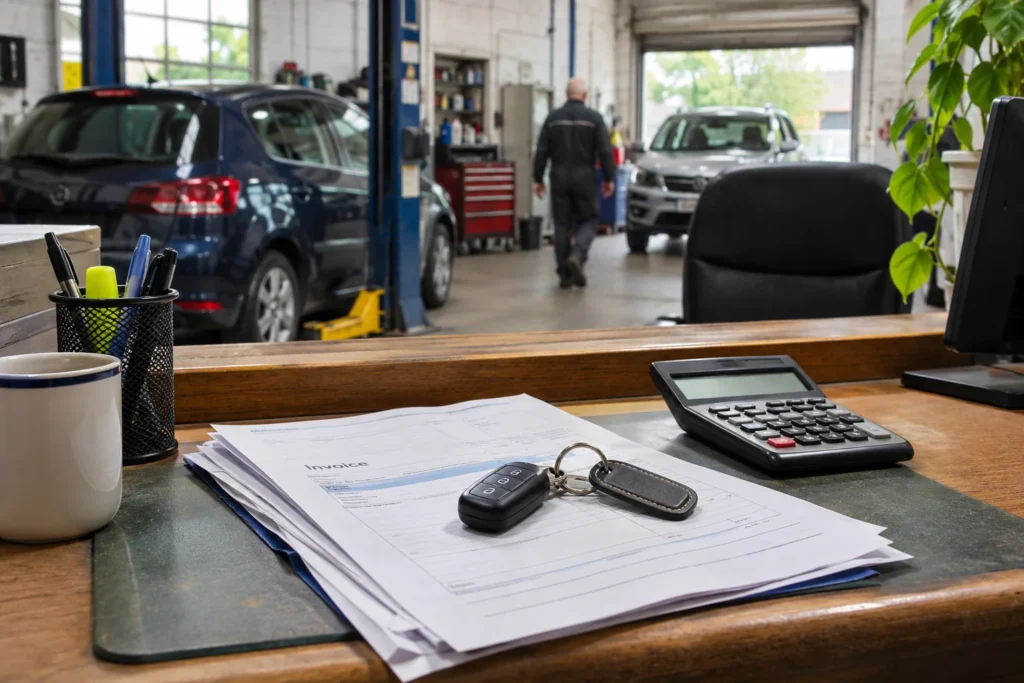
A line set to zero-rated can look like a line with no VAT to the customer. For VAT reporting, they are different. A zero-rated sale is a taxable supply at 0%. The approved centre’s qualifying MOT test fee sits outside the scope of VAT. A qualifying third-party disbursement has its own treatment. Pick the accounting system’s appropriate categories and check what they feed into when you sync the invoice. Start with one sample of each arrangement you actually use.
Sources: HMRC on zero-rated sales · HMRC on showing disbursements on invoices and keeping records
Keep the test station’s paperwork alongside the customer’s approval and your sales invoice. Make it easy to show that the amount collected matches the amount paid and that you kept the arranging charge separate. HMRC requires evidence for a payment you treat as a disbursement and says you cannot recover input VAT on that payment. If your garage is not VAT registered, you cannot issue a VAT invoice. Review your taxable turnover separately when deciding if registration is due.
Sources: HMRC VAT record keeping · HMRC VAT registration guidance
Northern Ireland uses the Driver & Vehicle Agency’s testing arrangements and has its own fee table. The published full test fee for a Class IV motor car is £38. Use its local process when quoting work there and identify any separately supplied garage services.
Sources: nidirect vehicle test fees · nidirect explanation of the MOT scheme
Before you invoice the next MOT, ask three questions. Who supplied the statutory test? If another station supplied it, did you pass on its exact charge under a qualifying agency arrangement? What fees did you earn yourself? Answer those three and the invoice is much easier to explain when the customer comes to collect the keys.
The free garage invoice template has a separate MOT line with no VAT, so the test fee stays apart from your VAT-able parts and labour.
